
A lower mortgage rate does not mean a lower total cost. And a home that fails to appraise is not automatically a lender’s problem to fix. A Denver home appraisal gap of $60,000 and a loan estimate that hid a higher payment both showed up in the same deal this summer. Catching both kept one buyer from overpaying twice.
The Loan Estimate That Looked Cheaper on Paper
A client came to us this summer already under contract. He called to compare rates before he signed anything. He was smart to be cautious. The average rate on a 30-year fixed mortgage sat at 6.66% for the week ending July 30, 2026, according to Freddie Mac’s Primary Mortgage Market Survey. That was up from 6.58% the week before. Rates are elevated, and Denver-area home prices are not cheap. He wanted the right deal for his family before committing to one.
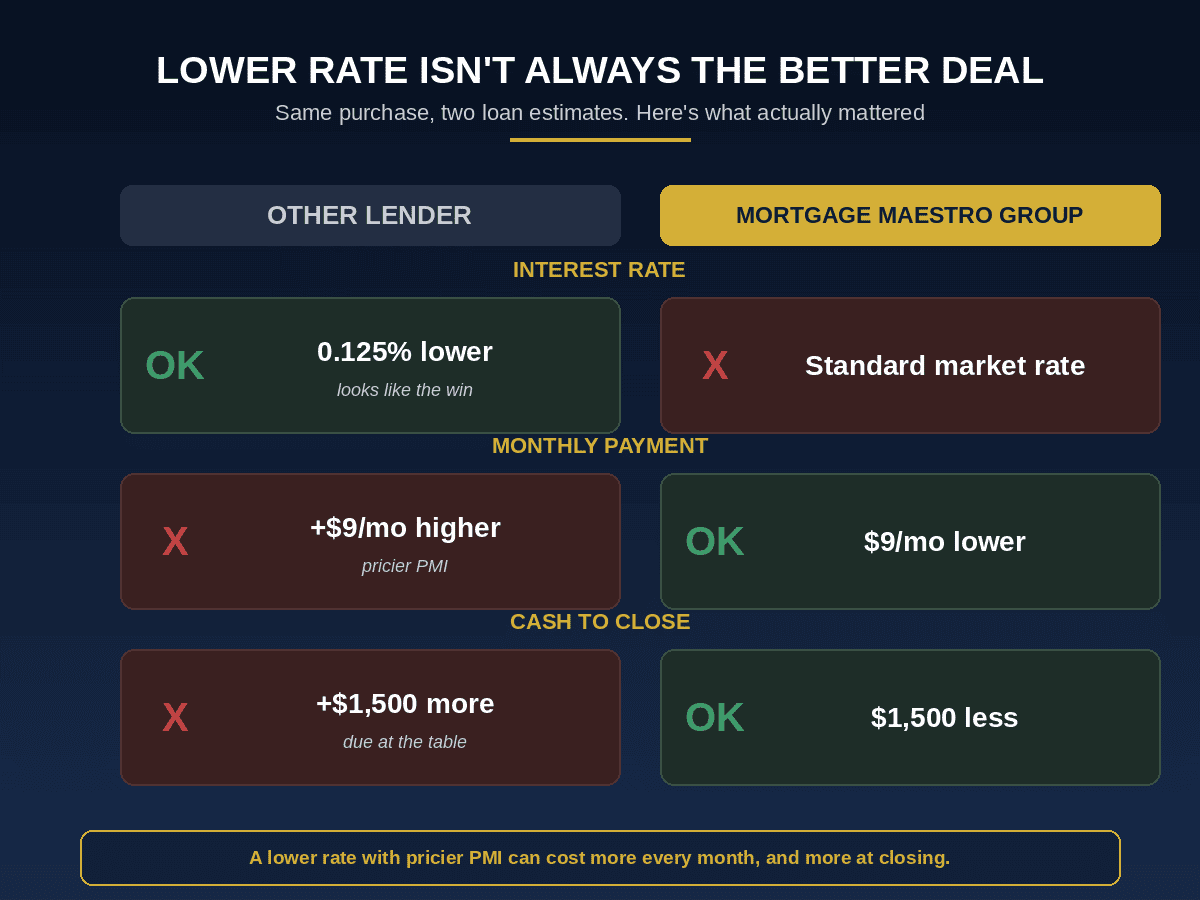
He sent over a competing lender’s loan estimate for comparison. At first glance it looked better, since the rate was 0.125% lower than ours. But the monthly payment on that “cheaper” estimate ran $9 higher. He also would have brought roughly $1,500 more to the closing table to get there. The difference traced back to one line most borrowers skip past: private mortgage insurance.
PMI on a conventional loan typically runs between 0.46% and 1.50% of the loan amount per year. That is roughly $30 to $70 a month for every $100,000 borrowed, per the Consumer Financial Protection Bureau and Freddie Mac. Credit score and loan-to-value drive where a borrower lands in that range. That is exactly why two lenders quoting a nearly identical rate can land on very different PMI costs. Here, the lower rate on paper carried a meaningfully pricier PMI structure. Once we walked through both loan estimates side by side, the “cheaper” option turned out to be the more expensive one every month.
This is the exact comparison the CFPB built the Loan Estimate to make possible. It is a standardized, three-page disclosure due within three business days of application. It shows the rate, the full monthly payment including mortgage insurance, closing costs, and cash to close, in the same format from every lender. The CFPB recommends pulling estimates from at least three lenders before deciding. Our take on how independent brokering stacks up against big banks covers why that comparison tends to favor a broker who shops multiple lenders on a client’s behalf.
Then the Denver Home Appraisal Gap Showed Up
Once the numbers were settled, the client raised a concern that had not come up on any earlier call. That is not an accident. Our team calls clients at intake and stays in touch throughout the file. Why? Lack of communication is the most common complaint we hear about other lenders. Over-communicating on purpose is how a concern like this surfaces early, instead of showing up as a surprise near closing.
The concern was about value. The listing agent had mentioned an appraisal was already done. It came back $60,000 under the contract price, about 12.6% short. Working the math backward makes the picture clear: a home priced around $476,000 that appraised closer to $416,000. Nationally, Fannie Mae’s research puts the odds of a contract price exceeding the appraised value at roughly 8% of purchase transactions. So gaps happen. But a gap of 12.6% is not a rounding error. When a home misses its price by that much, the likelier explanation is not a bad appraisal. It is a list price that was never supported by the data in the first place.
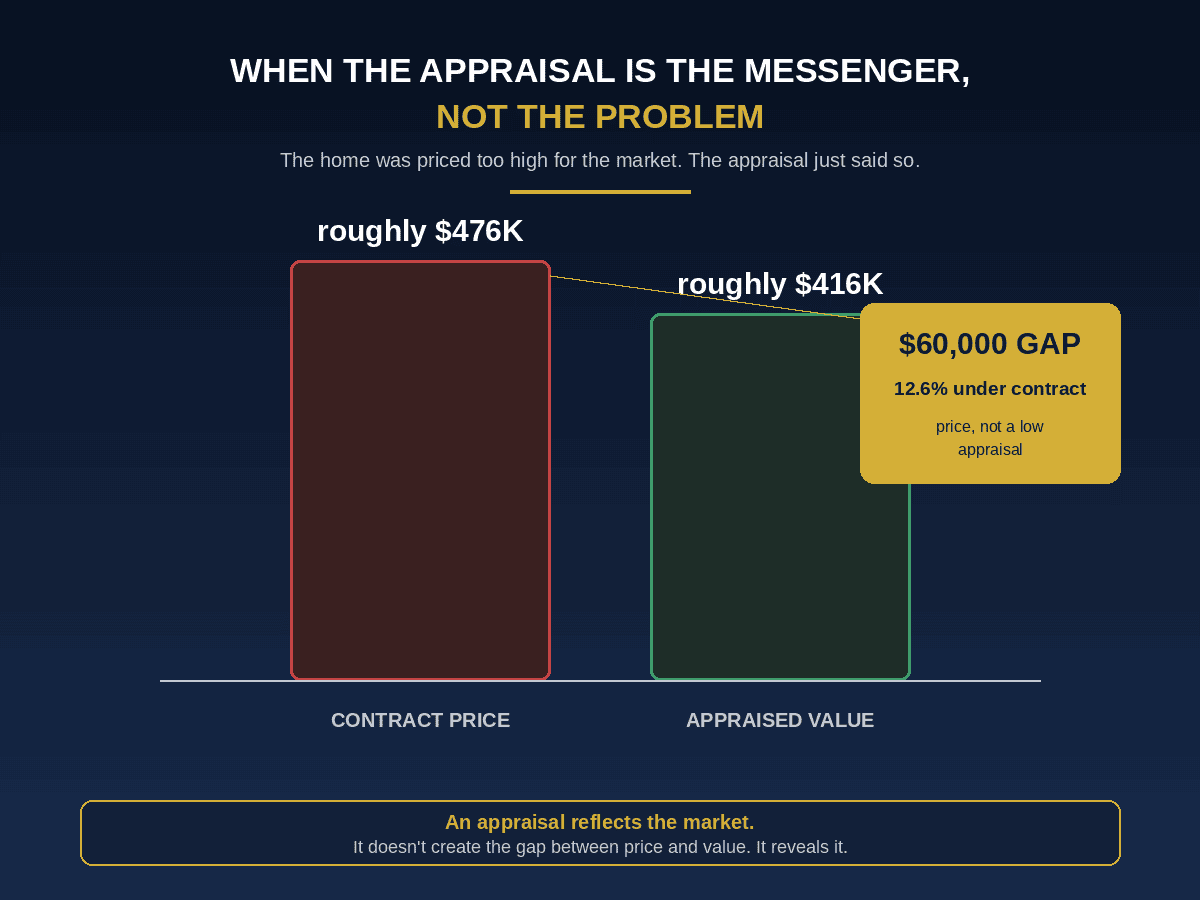
“A home that misses its price by twelve percent isn’t an appraisal problem, it’s a pricing problem. No amount of shopping for a new appraiser changes what the comparable sales are actually telling you.”
Ray Williams, President, Mortgage Maestro Group
The listing agent’s case rested on two things. First, the buyer had offered full price within two days of listing. Second, a couple of homes had sold higher two years earlier. Neither holds up well. A fast, full-price offer speaks to buyer urgency, not value. And sales from two years ago, in a market that has since cooled, are not really comparable. We asked whether the listing agent had met the appraiser on site with data to support the list price. The answer was no. A quick pull of current comparable sales turned up several similar homes. Every one was priced below, not above, this listing.
What a Low Appraisal Actually Means for Buyers and Sellers
A lender can only finance off the lower of the contract price or the appraised value. So a gap like this does not disappear on its own. Buyers and sellers generally have four ways to close it. The seller can lower the price to match. The buyer can bring extra cash to cover the difference. Either side can request a formal Reconsideration of Value if the appraisal itself looks flawed. Or the buyer can exit through an appraisal contingency. None of those options involve finding a different lender, because the lender did not set the price.
That is worth sitting with for the seller here too. This seller had owned the home for years. Trusting a listing agent’s number that the data does not support puts that seller at real risk of walking away upside down, or barely breaking even, once commissions and closing costs come off the top. The listing agent’s proposed fix was a new appraisal and a new lender. Our read, based on the comparable sales, is that the number needing a fix was the list price. We work well with agent partners who bring data to the table and want the outcome we do: a deal that closes on terms the numbers support. See our piece on why the person guiding your financing matters as much as the rate for more on this kind of advocacy.
The Real Lesson: Check the Number You Are Not Looking At
Both halves of this file come back to the same habit. The loan estimate that looked cheaper was not, once PMI got factored in. That appraisal gap read like a lending problem, but it was not, once the comparable sales got pulled. In each case, the number that mattered was not the headline number. It was the one sitting a few lines down that nobody had checked yet.
Frequently Asked Questions
Does a lower mortgage rate always mean a better deal?
No. Rate is one line on the loan estimate. PMI, lender credits, and closing costs can push the payment or the cash to close higher even at a lower rate. Compare the full loan estimate, not just the rate.
What does it mean when a home doesn’t appraise for the contract price?
The appraiser’s value came in below what the buyer agreed to pay. A lender can only finance off the lower of the two numbers, so the gap gets resolved through a price cut, extra cash from the buyer, a Reconsideration of Value, or an appraisal contingency.
How common is a Denver home appraisal gap?
Fannie Mae’s research shows the contract price beats the appraised value in roughly 8% of purchase transactions nationally. A small gap can be normal variation. A gap in the double digits more often points to a listing priced above what recent comparable sales support.
Can I dispute a low home appraisal?
Yes. Buyers and sellers can request a Reconsideration of Value, a process standardized across Fannie Mae, Freddie Mac, and FHA loans, when there is a real case the appraiser missed comparable sales. It works best backed by data, not just disagreement.
What should I compare besides the interest rate when shopping lenders?
Look at the full monthly payment including mortgage insurance, total cash to close, and any lender credits or fees. The CFPB recommends comparing loan estimates from at least three lenders, since the lowest rate does not always mean the lowest payment.
Get Your Numbers Checked Before You Sign Anything
If you are comparing loan estimates or waiting on an appraisal right now, do not take either number at face value. Request a side-by-side loan estimate comparison from Mortgage Maestro Group before you sign with any lender, and if a home comes in light on an appraisal, ask us to pull the comparable sales before assuming the appraisal was the problem. Call 303-779-0591 or visit mortgage-maestro.com.
Mortgage Maestro Group, NMLS #1838215, 387 N Corona St #646, Denver, CO 80218, is a veteran-owned, independent mortgage brokerage licensed in Colorado, California, Wyoming, Texas, and Florida. Equal Housing Opportunity.