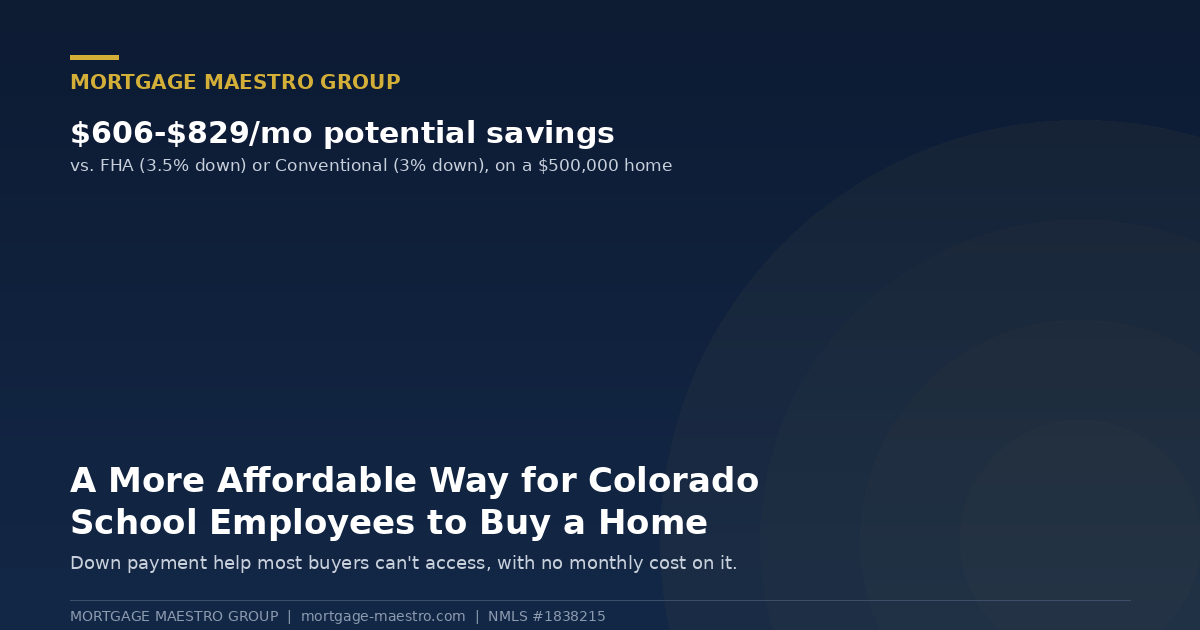

Mortgage Maestro Group offers down payment help for school employees across Colorado, a path to homeownership most buyers can’t access. Through the Schools To Home program, eligible school employees can receive a second mortgage worth up to 25% of their first loan amount, put toward a down payment or closing costs, with nothing owed monthly until they sell, refinance, or pay off the home. In exchange, the borrower shares a portion of the home’s future appreciation with the state’s Public School Permanent Fund (PSPF) when that day comes. On a $500,000 Denver home, that structure can mean real monthly savings. Financing the same home with FHA or Conventional low-down-payment options typically costs several hundred dollars more each month.
Watch Ray walk through exactly how the numbers work:
Who Qualifies for Schools To Home?
This program was built for the people who keep Colorado’s classrooms running, not only teachers with a classroom of their own. You qualify if you’re a full-time employee, as classified by your employer, of any of the following:
- A preK-12 Colorado public school
- A school district
- A charter school or institute charter school
- A board of cooperative educational services
- An innovation zone
That covers bus drivers, front-office staff, paraprofessionals, custodians, counselors, and administrators, not only classroom teachers. If you’re buying with someone else, only one of you needs to meet that test. You can check whether your employer qualifies on the Colorado Department of Education’s website. The program also requires a homebuyer education course before closing, so you go in understanding exactly what you’re agreeing to. That’s a good requirement. More buyers should take that course even when it isn’t mandatory, since it’s part of what makes this down payment help for school employees work responsibly.
How the Down Payment Assistance Actually Works
Here’s the mechanic almost nobody explains clearly. This down payment help for school employees works through a straightforward structure. Schools To Home pairs a normal, fixed-rate first mortgage with a second mortgage loan of up to 25% of that first loan amount. That second loan covers your down payment, your closing costs, or both. You make no monthly payment on it. It sits quietly behind your first mortgage until one of a few things happens. You sell, you refinance, you pay off the first mortgage, or the home stops being your primary residence. At that point, you repay the second loan’s principal plus a shared-appreciation payment to the PSPF. That’s the fund that made your purchase possible in the first place.
The program’s own published example shows exactly how the math resolves. A borrower buys a home for $437,500 with an $87,500 second mortgage, 25% of their $350,000 first loan. They later sell for $480,000, a $42,500 gain. Because their DPA was 25% of the first mortgage, they share 25% of that gain, $10,625, with the PSPF. They repay $87,500 plus $10,625 (a total of $98,125) and keep $31,875 of the appreciation for themselves. The program is explicit that your shared-appreciation percentage will never exceed the percentage of DPA you received. And if the home doesn’t appreciate, you owe nothing on that portion at all.
What This Looks Like on a $500,000 Denver Home
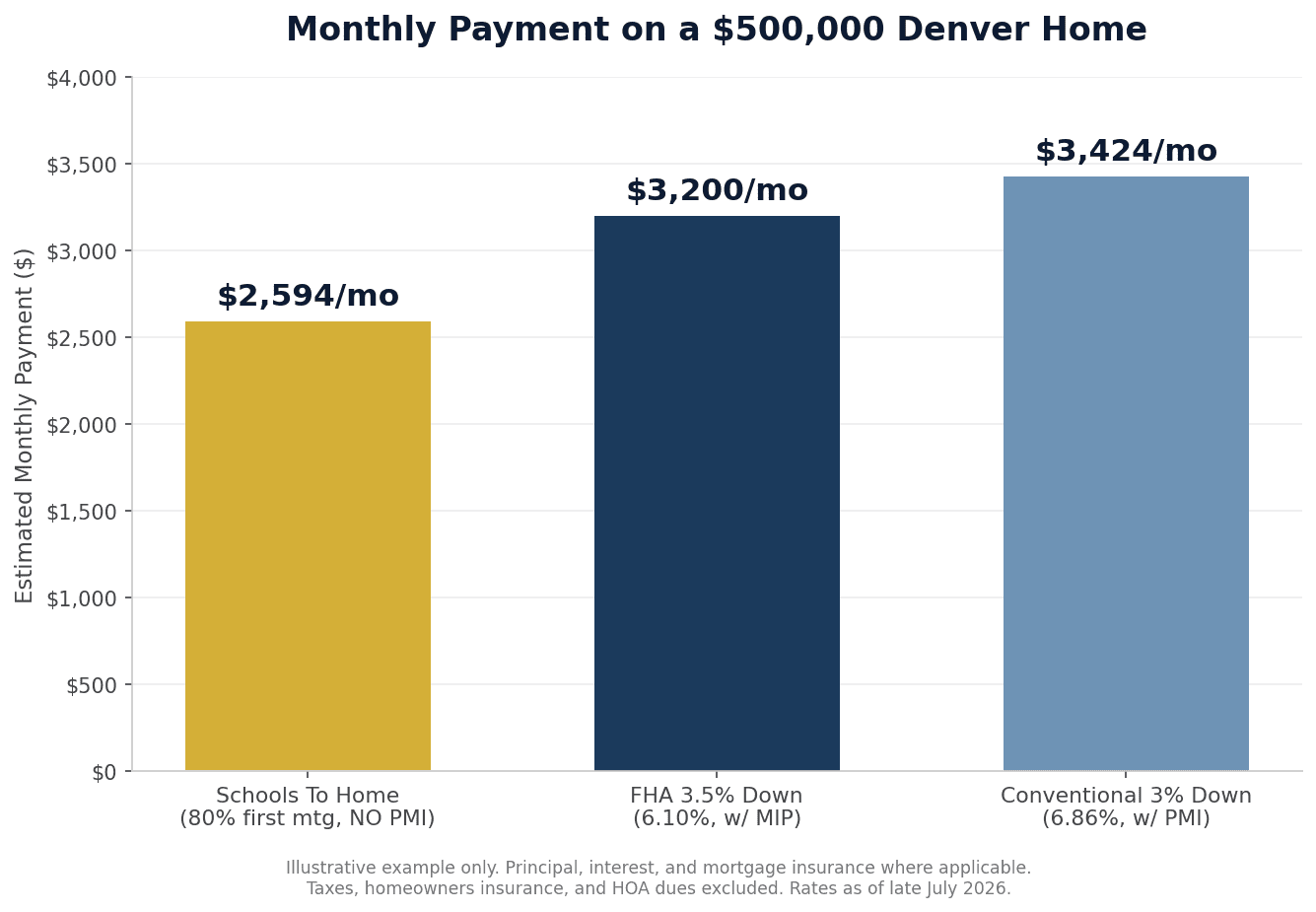
Numbers make this real faster than any explanation. Here’s a side-by-side using a $500,000 home, a 6.75% rate on the Schools To Home first mortgage, and Mortgage News Daily’s posted averages for the alternatives as of late July 2026 (FHA at roughly 6.10%, Conventional at roughly 6.86%). Estimates below cover principal, interest, and mortgage insurance where it applies. Property taxes, homeowners insurance, and HOA dues aren’t included. Those costs stay the same no matter how you finance the home.
Schools To Home: a $400,000 first mortgage at 6.75%, no mortgage insurance because the first lien sits at 80% loan-to-value. Estimated payment: $2,594/month.
FHA, 3.5% down: a $482,500 base loan plus financed upfront mortgage insurance, at roughly 6.10%. Estimated payment with monthly MIP: $3,200/month.
Conventional, 3% down: a $485,000 loan at roughly 6.86%, with estimated private mortgage insurance. Estimated payment with PMI: $3,424/month.
That’s a difference of roughly $606 a month against FHA. Against Conventional financing on the exact same house, the gap widens to $829 a month. The reason isn’t the rate alone. It’s that the second mortgage does the job PMI and MIP exist to cover. It just doesn’t charge a monthly premium for it.
Note: if the “D.P.A.” you had in mind is the standard DPA Second Mortgage (up to 4% of the first loan, capped at $25,000), it typically pairs with FHA or Conventional financing at standard down payment levels. That means the monthly payment lands close to the FHA or Conventional lines above. Its advantage is covering closing costs and reducing cash needed at the table, not lowering the payment itself. Schools To Home is structurally different because the assistance is large enough to eliminate mortgage insurance entirely.
What If You Invested the Difference Instead?
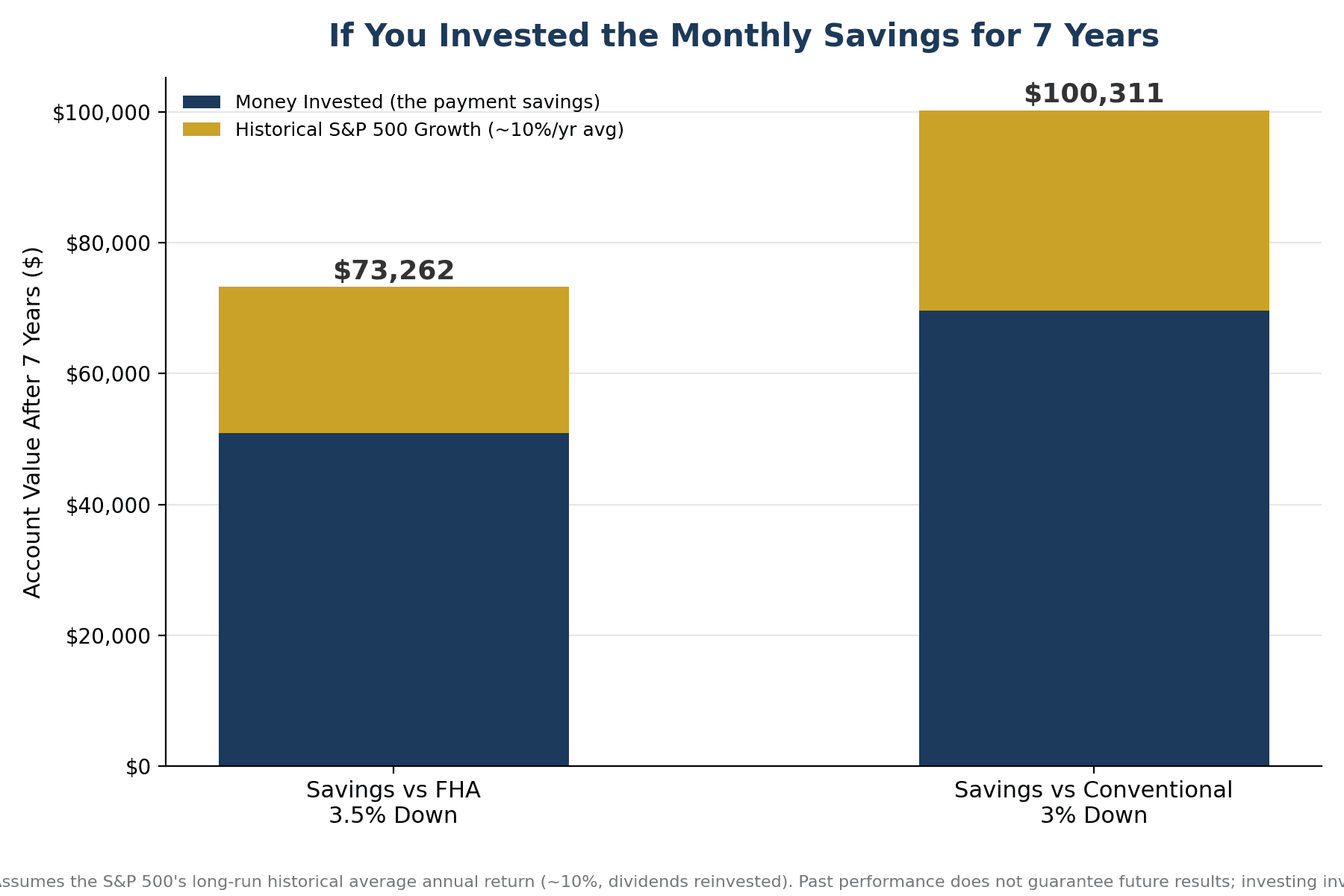
Here’s where it gets interesting for anyone thinking past next month’s payment. Take that monthly savings and put it into an S&P 500 index fund instead of spending it. The S&P 500 has averaged close to 10% a year over its full history, with dividends reinvested. Any given seven-year stretch can run hotter or colder than that average, and investing always carries the risk of loss.
If you invested the $606 monthly savings versus FHA financing for seven years at that historical average, you’d have contributed about $50,880. You’d end up with roughly $73,262. That’s a $22,381 gain from growth alone. Invest the $829 monthly savings versus Conventional financing over the same seven years. You’d contribute about $69,666 toward a balance of roughly $100,311. That’s a $30,645 gain.
That’s real money earning a return during exactly the years you’d otherwise be sending it to a mortgage insurance company. That company gives none of it back.
Or, Buy the Home That’s Already Move-In Ready
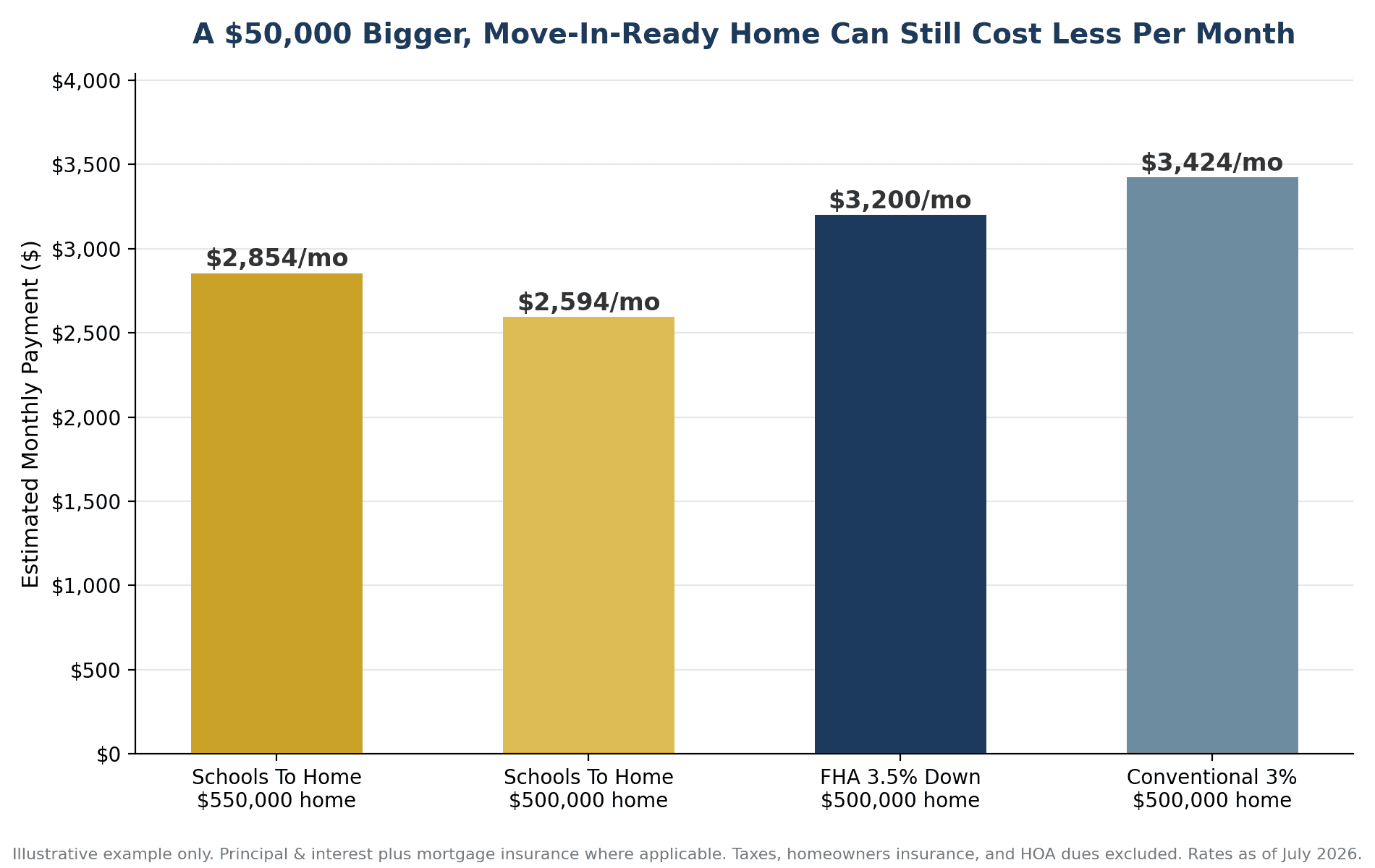
Not everyone wants to invest the difference. Some people would rather never touch a paint sprayer. Because Schools To Home’s structure is this efficient, you can often step up in price. You’ll still come out ahead of standard financing.
A $550,000 home under the same Schools To Home structure (a $440,000 first mortgage, a $110,000 second) runs about $2,854/month, only about $259 more than the $500,000 version. That’s still roughly $346/month less than financing the smaller $500,000 home with FHA 3.5% down, and roughly $570/month less than financing it with Conventional 3% down. In plain terms: the extra $50,000 of house, the one that doesn’t need a new roof or a kitchen redo the year after you move in, can cost less than the “cheaper” home financed the ordinary way.
What About Homeowners Who Feel Stuck Where They Are?
This is the conversation Ray has more than any other lately. A lot of Colorado school employees already own a home, locked in a rate two or three points below today’s market, and the math has kept them frozen in place. Moving means giving up that rate, and on paper, that feels like a step backward.
“Most people think their rate is the only lever they can pull. This program pulls a completely different lever. It gives Colorado’s school employees the down payment itself. Then it pays that help back out of future appreciation instead of out of their paycheck every month. When I run the numbers for a client who’s felt stuck, something shifts. That’s usually the moment they realize they’re not actually trapped. They’re just financing their next move the wrong way.”
Ray Williams, President, Mortgage Maestro Group
If you’re an eligible school employee sitting on equity in your current home, take heart. Selling doesn’t have to mean a step backward. You can take your proceeds and pay down higher-interest debt, invest the rest, or simply keep more cash on hand. Either way, you can still land an affordable payment on the next home. That’s because Schools To Home covers the piece that would otherwise force your payment up. The program was built for exactly this: making the next move pencil out, even in a higher-rate environment.
Illustrative only, confirm with your loan officer: using the same ratio the program applies in its own example, a $100,000 second mortgage on the $500,000 example home would carry a shared-appreciation obligation of roughly $28,734 after 7 years of 3% annual appreciation (on a home worth about $614,937), or roughly $45,108 after 7 years of 4.5% annual appreciation (on a home worth about $680,431). In the slower-appreciation case, the borrower keeps about $86,203 of the gain; in the faster case, about $135,323. Your actual shared-appreciation percentage is fixed at closing and disclosed before you sign.
The Real Estate Agent Advantage
Working with an approved partner agent on your purchase adds another layer of savings on top of the loan structure itself: up to an additional 1% toward your home purchase. Ask your loan officer which local agents participate before you start touring homes. It’s a benefit worth locking in before you write an offer, not after.
If Schools To Home isn’t the right fit, or you want to see how it stacks up against other options, our complete guide to Denver down payment assistance programs covers the full lineup, and Down Payment Assistance Mastery walks through stacking this program with local and alternative programs.
Frequently Asked Questions
Who is eligible for the Schools To Home program?
Any full-time employee, as classified by their employer, of a Colorado preK-12 public school, school district, charter school, institute charter school, board of cooperative educational services, or innovation zone. If more than one borrower is on the loan, only one needs to meet this requirement. That eligibility is exactly what makes this down payment help for school employees possible.
How much down payment assistance can I get through Schools To Home?
Up to 25% of your first mortgage loan amount, usable for your down payment, your closing costs, or both.
Do I have to repay the Schools To Home down payment assistance?
Yes, but not monthly. Repayment, along with a shared-appreciation payment to the Public School Permanent Fund, is deferred until you sell, refinance, pay off your first mortgage, or the home stops being your primary residence.
Will I owe a shared-appreciation payment if my home doesn’t go up in value?
No. The program states that any negative appreciation is treated as zero, and your shared-appreciation percentage will never exceed the percentage of down payment assistance you received.
Can I use Schools To Home if I already own a home?
Yes, as long as you meet the employment requirement. Many eligible buyers use it to move up rather than to buy for the first time, especially when their current rate has made moving feel financially out of reach.
Take the Next Step
If you work for a Colorado public school, in any role, and you’ve been waiting for the math to make sense, this down payment help for school employees may be the program that changes the math. Fill out the contact form on our site and note “Schools To Home” as the reason you’re reaching out, and we’ll walk through your specific numbers together: not a generic example, yours.
This article is for illustrative purposes only. Rates, loan limits, and program terms are subject to change without notice; confirm current details with an approved participating lender. Mortgage insurance and PMI figures shown are estimates and will vary based on credit score, loan program, and insurer pricing. Historical S&P 500 returns are not a guarantee of future performance, and investing involves the risk of loss. Mortgage Maestro Group, NMLS #1838215. Equal Housing Opportunity. 387 N Corona St #646, Denver, CO 80218. 303-779-0591.