
Market information checked September 25, 2026.Weighing a HELOC vs. HELOAN is one of the first decisions a Denver-area family faces when using home equity to reorganize expensive debt and make monthly payments more manageable. A fixed-rate home equity loan usually suits a known balance and a predictable payoff plan. A HELOC offers flexible borrowing, but its rate and payment can change. Neither option fixes a budget that requires new debt every month, and both put your home at risk if you cannot repay.
Groceries, childcare, insurance renewals and the commute can leave little room between payday and the next round of bills. Meanwhile, a family may have substantial equity in its home but very little cash available.
At Mortgage Maestro Group, our starting point is the household’s complete financial picture: what you owe, what the payments accomplish, and what remains after the bills clear. The goal is a repayment plan your family can sustain, with enough room for the expenses life rarely schedules.
Higher rates add pressure, but not every loan moves the same way
On September 16, 2026, the Federal Reserve raised its federal funds target range by 0.25 percentage point to 3.75%-4.00%. Separately, Freddie Mac’s national 30-year fixed mortgage average rose from 6.76% on September 10 to 7.03% on September 24. That mortgage average is market context, not a HELOC or home equity loan quote.
The Fed does not directly set your mortgage rate. A variable HELOC often follows an index such as prime, plus a lender margin, subject to its contract. In contrast, an existing fixed-rate home equity loan keeps its contracted rate. New fixed-rate offers reflect broader funding conditions and the borrower’s qualifications.
Local price pressure also matters. The Bureau of Labor Statistics reported that Denver-Aurora-Lakewood consumer prices were 3.9% higher in July 2026 than a year earlier, even though they fell 0.7% over the latest two-month period. Grocery prices were up 2.9% over the year. These figures measure price changes, not what every Denver family spends or how Denver’s price level compares with another city.
Your own renewal notices and bank statements are more useful than an average when deciding how much payment you can handle. A Lakewood homeowner and an Aurora homeowner with the same income may have very different childcare, commuting, HOA and insurance costs.
HELOC vs. HELOAN: flexibility or a defined payoff?
A home equity line of credit, or HELOC, lets you draw, repay and generally borrow again within an approved limit during its draw period. A home equity loan, sometimes called a HELOAN, provides a lump sum. The comparison below assumes a traditional fixed-rate, fully amortizing HELOAN, meaning scheduled payments repay the entire balance by the end of its term.
| Decision point | HELOC | Fixed-rate HELOAN |
|---|---|---|
| How you receive money | Draw as needed within the line’s rules; an initial draw may be required. | One lump sum at funding. |
| Rate and payment | Usually variable; some plans offer fixed-rate conversions. | Fixed principal-and-interest payment over the agreed term. |
| Paying down debt | Interest-only payments, if allowed, do not reduce principal. | Scheduled payments reduce principal from the start. |
| Potential fit | A defined need with uncertain timing and a reliable repayment source. | A known amount to consolidate, with payment certainty as a priority. |
| Main caution | Rate increases, repeat borrowing and the end of the draw period. | Borrowing more than needed or stretching repayment too long. |
| Home and first mortgage | Both use your home as collateral. When added as a second lien, neither replaces your existing first mortgage. | |
The CFPB’s product comparison explains the basic distinction. Actual loan terms vary. For more product detail, see our Denver home equity loan guide and HELOC guide.
Start with the reason your budget is short
Before choosing a loan, separate three different situations.
- Expensive existing debt: You can cover ordinary living costs, but high-interest balances consume the monthly margin. Restructuring may help if you stop rebuilding those balances.
- A temporary, defined expense: You need to pay for a necessary repair or bridge a documented timing gap. Identify the amount, deadline and repayment source before borrowing.
- An ongoing shortfall: Normal spending exceeds take-home pay even before extra debt payments. Borrowing against the house can postpone the problem while increasing the stakes.
Build the budget from recent statements. Include annual expenses divided by 12: insurance deductibles, home maintenance, school costs, vehicle repairs and holiday spending. Otherwise, an apparently balanced budget may depend on the next credit-card charge.
A central Denver example: accumulated equity and $40,000 in debt
Consider an illustrative central Denver family, not an actual client. They bought their home for $575,000 with a $115,000 down payment and a $460,000 first mortgage. For this example, assume the home is now worth $750,000 and the mortgage balance has declined to $410,000. These are hypothetical property figures, not neighborhood averages, a valuation or a forecast.
| Where the equity came from | Amount |
|---|---|
| Original down payment | $115,000 |
| Assumed increase in home value | $175,000 |
| Mortgage principal repaid | $50,000 |
| Current equity: $750,000 minus $410,000 | $340,000 |
They have accumulated $225,000 in additional equity beyond their down payment. However, that equity is not cash in a bank account, and a lender will not necessarily let them borrow all of it.
The family wants to pay off the following balances. To keep the rate comparison transparent, all three cards carry an assumed 24% APR. Their current planned payments total $1,200 per month; these are illustrative household payments, not a universal card minimum formula.
| Debt | Payoff balance | Assumed APR | Current monthly payment |
|---|---|---|---|
| Credit card A | $18,000 | 24% | $540 |
| Credit card B | $12,000 | 24% | $360 |
| Credit card C | $10,000 | 24% | $300 |
| Total | $40,000 | 24% | $1,200 |
A $40,000 HELOAN would pay those balances and leave the $410,000 first mortgage intact. Combined mortgage debt would become $450,000, or 60% of the assumed $750,000 value. Remaining home equity would be $300,000 before selling costs or value changes. The family would still owe $450,000 across its mortgages, so this transaction reorganizes debt rather than creating wealth.
The fixed-rate HELOAN alternative: approximately $693 more monthly breathing room
At a hypothetical 9% fixed rate over ten years with no fees, the $40,000 HELOAN payment would be $506.70. Compared with the family’s current $1,200 card payments, that frees $693.30 per month, or about $8,320 over a year, if spending and other payments stay unchanged. This is payment relief, not an estimate of interest saved.
If instead they paid $1,500 in closing costs from savings, the monthly payment would stay the same, but their cash reserve would fall by $1,500. The first year’s payment relief minus that upfront cash outlay would be about $6,820. This is only a liquidity comparison, not a full economic break-even calculation. Financing fees would increase the loan balance and payment; request a fresh calculation and the actual APR.
Compare the payoff timeline as well as the monthly savings
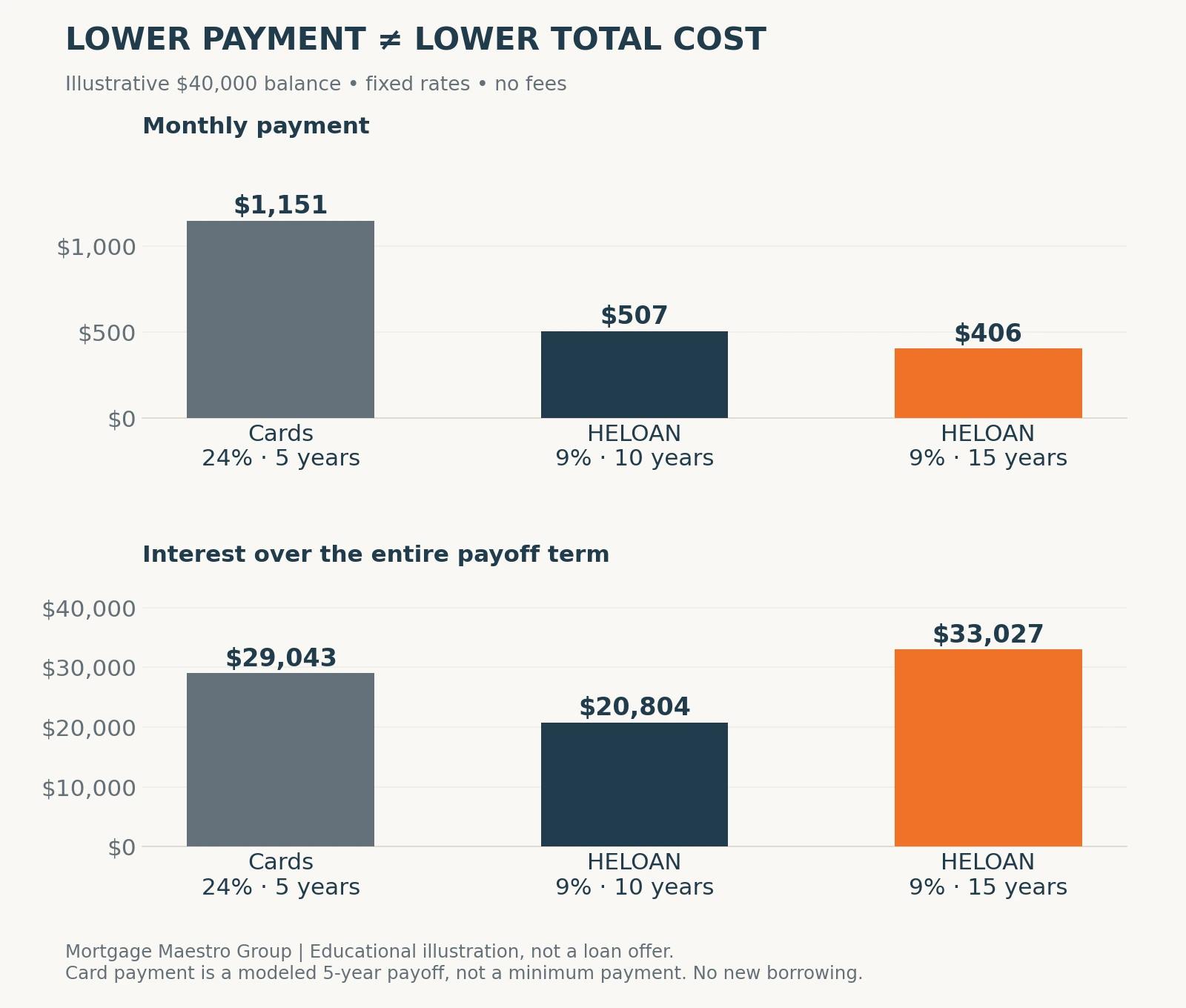
The table below uses a separate, standardized five-year card payoff to show how loan term changes the result. Its calculated $1,150.72 card payment differs from this family’s current $1,200 payment.
Calculation assumptions: The card balance stays at a hypothetical 24.00% annual rate/APR; both HELOAN examples use a hypothetical 9.00% fixed rate and 9.00% APR with zero fees. All balances start at $40,000, payments occur monthly, and there are no new charges or extra payments. These are educational calculations, not available loan offers or current market quotes. Actual fees would increase borrowing costs and may increase APR.
| Payoff plan | Monthly payment | Total interest | Total payments |
|---|---|---|---|
| Cards: 24%, 60 payments | $1,150.72 | $29,043 | $69,043 |
| HELOAN: 9%, 120 payments | $506.70 | $20,804 | $60,804 |
| HELOAN: 9%, 180 payments | $405.71 | $33,027 | $73,027 |
Totals use unrounded amortization calculations and round to the nearest dollar; final payment adjustments can differ. The card payment is a calculated five-year payoff amount, not an issuer’s minimum. HELOAN payments exclude the separate first mortgage, property taxes, homeowners insurance and HOA dues, which still must be paid.
The ten-year HELOAN reduces the illustrated monthly obligation by about $644. However, the fifteen-year version costs about $3,984 more in total interest than the five-year card payoff, despite its much lower rate.
How the extra room shows up in the family’s monthly budget
\n
Now suppose this family has $8,500 in monthly take-home pay and $6,900 in other planned spending, including its first mortgage, housing costs and reserves for irregular bills. Its current $1,200 card payments leave $400 each month. The ten-year HELOAN leaves about $1,093, before any one-time closing costs.
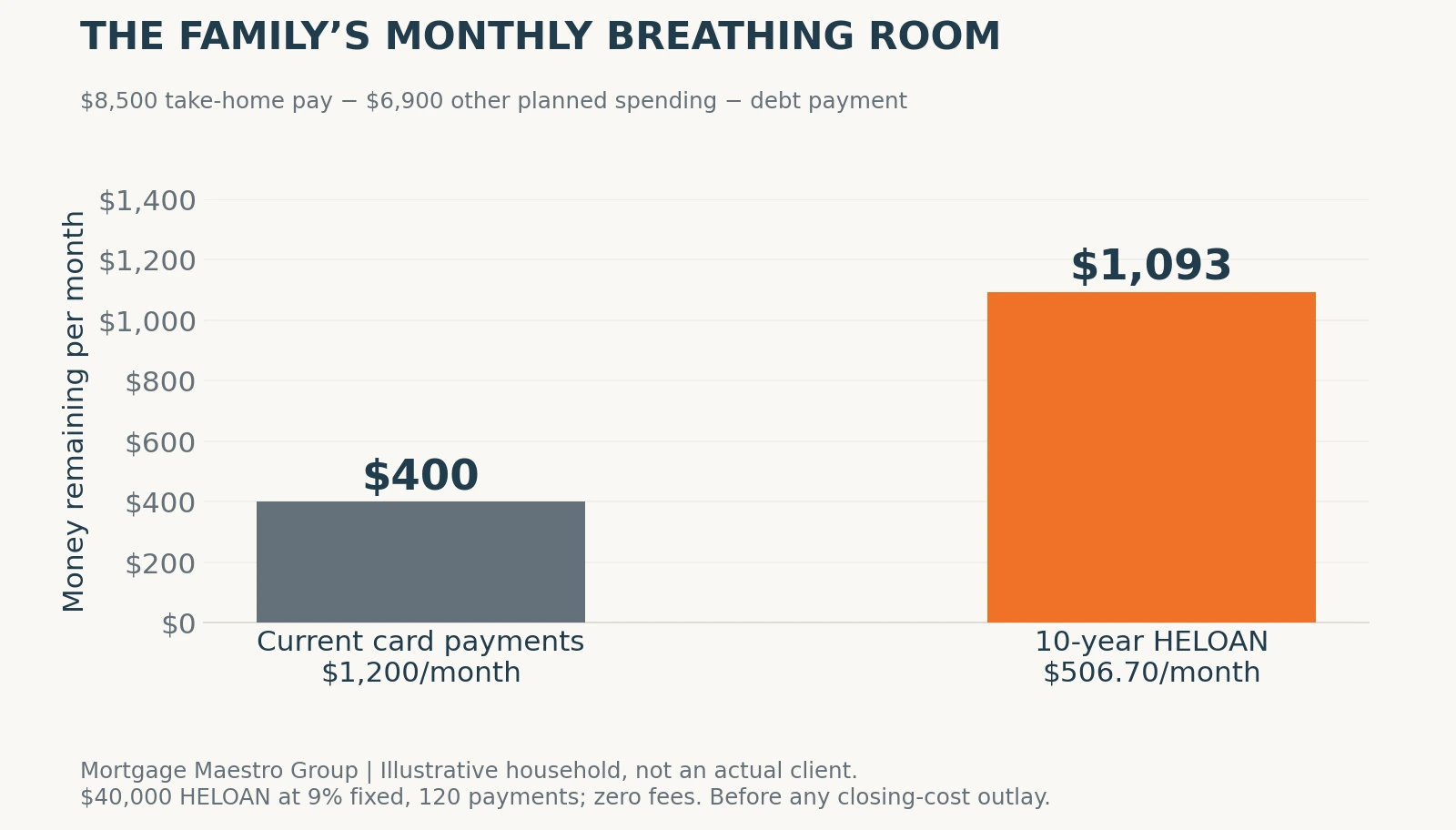
As a result, that additional $693 could rebuild a cash reserve or support faster debt repayment. It is not additional income. If the family adds $693 in new monthly spending instead, the restructuring has not strengthened its budget. Agree on where that monthly margin will go before signing.
Most importantly, though, paying the cards with home equity moves that debt onto the house. The debt has not disappeared, and failure to pay the new loan can lead to foreclosure.
Stress-test a HELOC beyond its opening payment
An interest-only payment can look appealing when cash flow feels tight. Yet it leaves the borrowed principal unpaid. The CFPB warns that HELOC payments can rise substantially when repayment begins. A lender may also freeze additional borrowing in certain circumstances, so an unused line is not the same as cash savings.
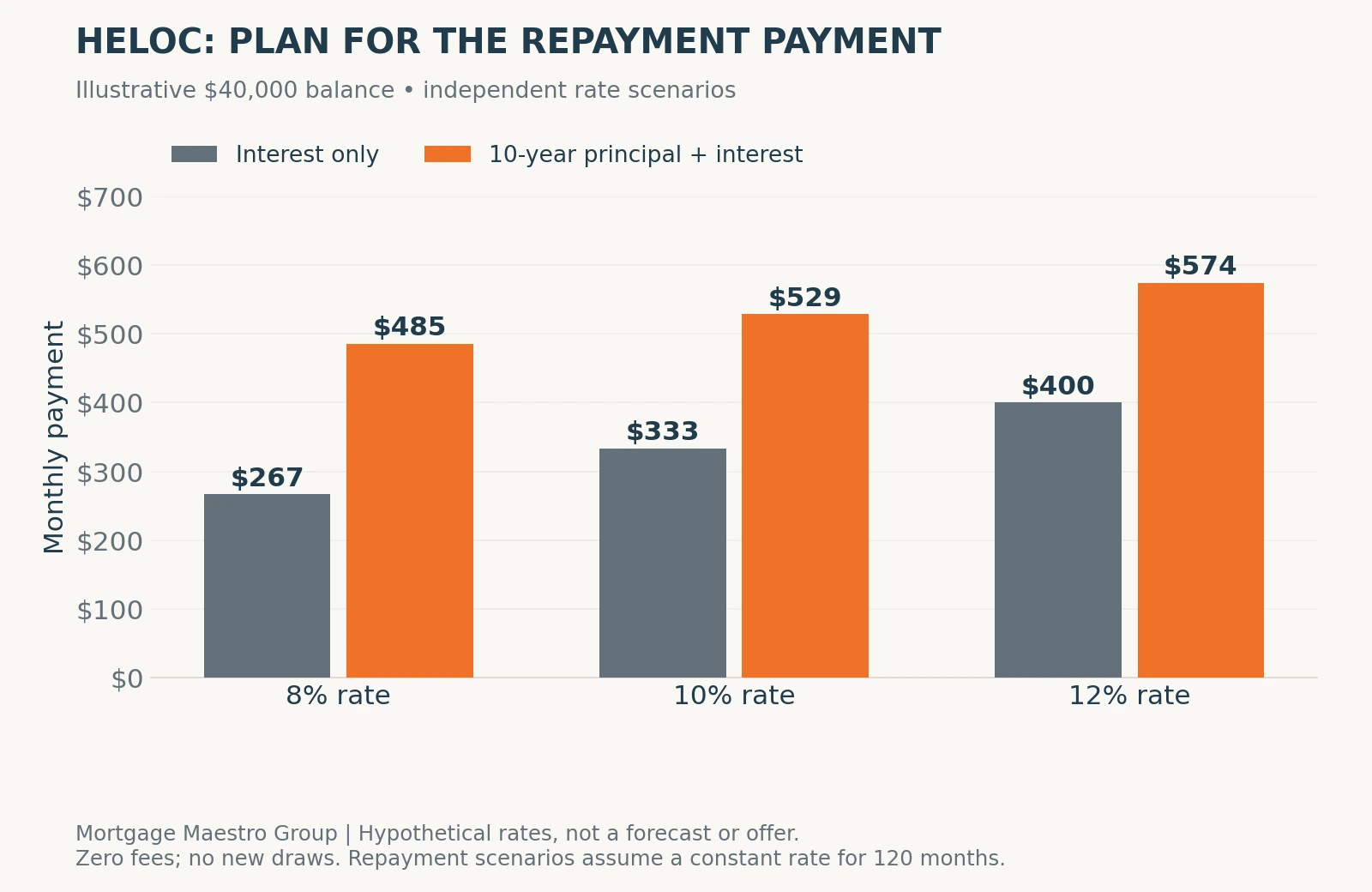
The following independent scenarios assume an unchanged $40,000 balance. They compare interest-only payments with payments that would repay that balance over ten years at the same assumed rate. They are stress tests, not forecasts or lender quotes.
| Assumed annual rate | Interest only, per month | Ten-year principal and interest, per month |
|---|---|---|
| 8% | $266.67 | $485.31 |
| 10% | $333.33 | $528.60 |
| 12% | $400.00 | $573.88 |
Hypothetical rates; zero fees; no additional draws. Each repayment calculation assumes 120 monthly payments and a constant rate for that scenario. Actual HELOC rates may change, and actual draw periods, repayment terms, minimum payments and rate caps differ.
At 10%, the payment rises from about $333 to $529 solely because principal repayment begins. Before selecting a HELOC, ask for its index, margin, introductory-rate expiration, adjustment schedule, floor, cap and repayment schedule. Also ask what a fixed-rate conversion would cost and which balances it covers.
Protect a favorable first mortgage, but compare the whole plan
A family with a low fixed first-mortgage rate may prefer a second lien over replacing the entire mortgage. A cash-out refinance changes the financing on the existing balance as well as the extra money borrowed.
Still, however, keeping the first mortgage is not automatically the best answer. Compare both payments, closing costs, remaining terms, total interest and balances at your likely moving date. Our mortgage refinance overview explains the broader planning conversation.
Watch: cash-out refinance versus HELOC
Mortgage Maestro Group’s video, Cash-Out Refinance vs. HELOC: What’s Right for You?, provides background on these two ways to access equity. It was published in March 2025. Treat its market references as historical, and use current written quotes for today’s decision. The fixed-rate HELOAN comparison in this article adds a third option.
Is now a sensible time to use home equity?
The right timing depends on whether a current, documented offer improves a workable repayment plan. Do not rely on a future Fed cut, home appreciation or another refinance to make the payments affordable.
- Explore a fixed HELOAN when the amount is known, predictable payments matter and the term fits your payoff goal.
- Explore a HELOC when spending has a defined purpose but uncertain timing, and you can afford higher payments without drawing more to cover them.
- Pause new borrowing when income is unstable, everyday expenses keep exceeding income or the plan requires home values to rise.
Alternatives deserve a fair comparison. These may include a creditor hardship arrangement, an unsecured personal loan, a carefully planned balance transfer, or nonprofit credit counseling. Compare fees and repayment deadlines. If housing payments are already becoming difficult, contact your mortgage servicer promptly rather than assuming a new equity loan will be available.
Qualification and costs: what to check
Available equity is only part of approval. Lenders also evaluate credit, income, existing obligations, property eligibility and combined loan-to-value, or CLTV. CLTV compares total liens with the home’s appraised value; HELOC calculations may use the full credit limit. Requirements vary by program.
For our central Denver example, an illustrative 80% CLTV limit would permit $600,000 in combined liens on a $750,000 home. Subtracting the $410,000 first mortgage leaves $190,000 before other restrictions. Yet the family’s defined payoff need is only $40,000. A hypothetical lending ceiling is not a spending target, an approval or a reason to borrow more.
Request an itemized cost comparison. Include appraisal, title, origination, annual, transaction and early-closure charges where applicable. The FTC explains that a HELOC’s disclosed APR generally reflects interest alone, while a home equity loan’s APR includes certain additional credit costs. Comparing the two APRs without their fees can mislead.
Build a cash-flow plan with Mortgage Maestro Group
Bring your latest mortgage statement, debt balances and rates, required payments, take-home income, monthly budget and any existing loan offer. Include how long you expect to stay in the home and the cash reserve you want to preserve.
Ray Williams and the Mortgage Maestro Group team can help compare keeping your current structure, adding a HELOC, taking a fixed home equity loan or refinancing. The useful outcome is clarity about the payment, payoff date, cost and risk, including when borrowing more does not make sense.
Schedule a cash-flow strategy consultation
Frequently asked questions
Can I use a HELOC or HELOAN without refinancing my first mortgage?
Yes. When structured as a separate second lien, either can leave your first mortgage in place. You still must qualify, and your budget must support both obligations.
Does paying off credit cards with home equity erase the debt?
No. You replace the card balances with debt secured by your home. A lower required payment may help cash flow, but a longer term can increase total interest, and missed payments can put your home at risk.
What if I sell my home before the equity loan is paid off?
You generally need to pay off the outstanding home equity loan or HELOC as part of the sale. Request a payoff statement and check any early-closure charges when estimating your net proceeds.
Can a HELOC serve as my emergency fund?
It should not replace cash reserves. A lender may restrict additional draws under certain conditions, and borrowing for an emergency adds a repayment obligation. Keep a separate cash cushion when feasible.
Should I include a tax deduction when estimating savings?
Do not assume one. Tax treatment depends on the use of proceeds, applicable law and your circumstances. Have a qualified tax professional evaluate the proposed transaction; the examples here include no tax benefit.
Educational information, not a commitment to lend or individualized financial, legal or tax advice. Rates, fees, approval and terms vary. Borrowing against home equity can result in foreclosure if obligations are not met. Mortgage Maestro Group, Maestro LLC, NMLS #1838215. Equal Housing Opportunity.