
Buying a home with $50,000 saved may be possible, but that balance alone does not tell you what you can comfortably afford. The better starting point is how much cash you want left after closing and what monthly payment still lets you save, maintain the home and live your life.
At Mortgage Maestro Group, I want buyers to understand that distinction before they fall in love with a property. A loan approval answers a financing question. Your household budget answers a different question: can you carry this home without depending on everything going according to plan?
As a mortgage broker, business owner and real-estate investor, I look at both. Buying well includes planning for the months and years after you move in.
Buying a home with $50,000 saved: give every dollar a job
First, separate money available for the purchase from money you need to keep. Your savings may need to cover the down payment, closing expenses, moving, immediate repairs and an emergency cushion.
The CFPB’s down-payment planning guide makes this same distinction: account for closing costs and initial home expenses before deciding how much to put down.
Here is a hypothetical allocation for a $400,000 purchase. These are planning assumptions, not a client’s finances, a loan quote or a statement that this price fits your income. The $10,000 closing allowance includes assumed loan and third-party costs, prepaid expenses and initial escrow funding; actual amounts vary.
| Use of savings | 5% down | 7.5% down |
|---|---|---|
| Down payment | $20,000 | $30,000 |
| Closing allowance | $10,000 | $10,000 |
| Moving and immediate work | $5,000 | $5,000 |
| Cash remaining after those expenses | $15,000 | $5,000 |
| Base loan before any financed charges | $380,000 | $370,000 |
The larger down payment reduces the starting debt by $10,000. However, it also leaves $10,000 less in cash. Whether that tradeoff makes sense depends on actual loan pricing, mortgage insurance, household expenses and your ability to rebuild savings.
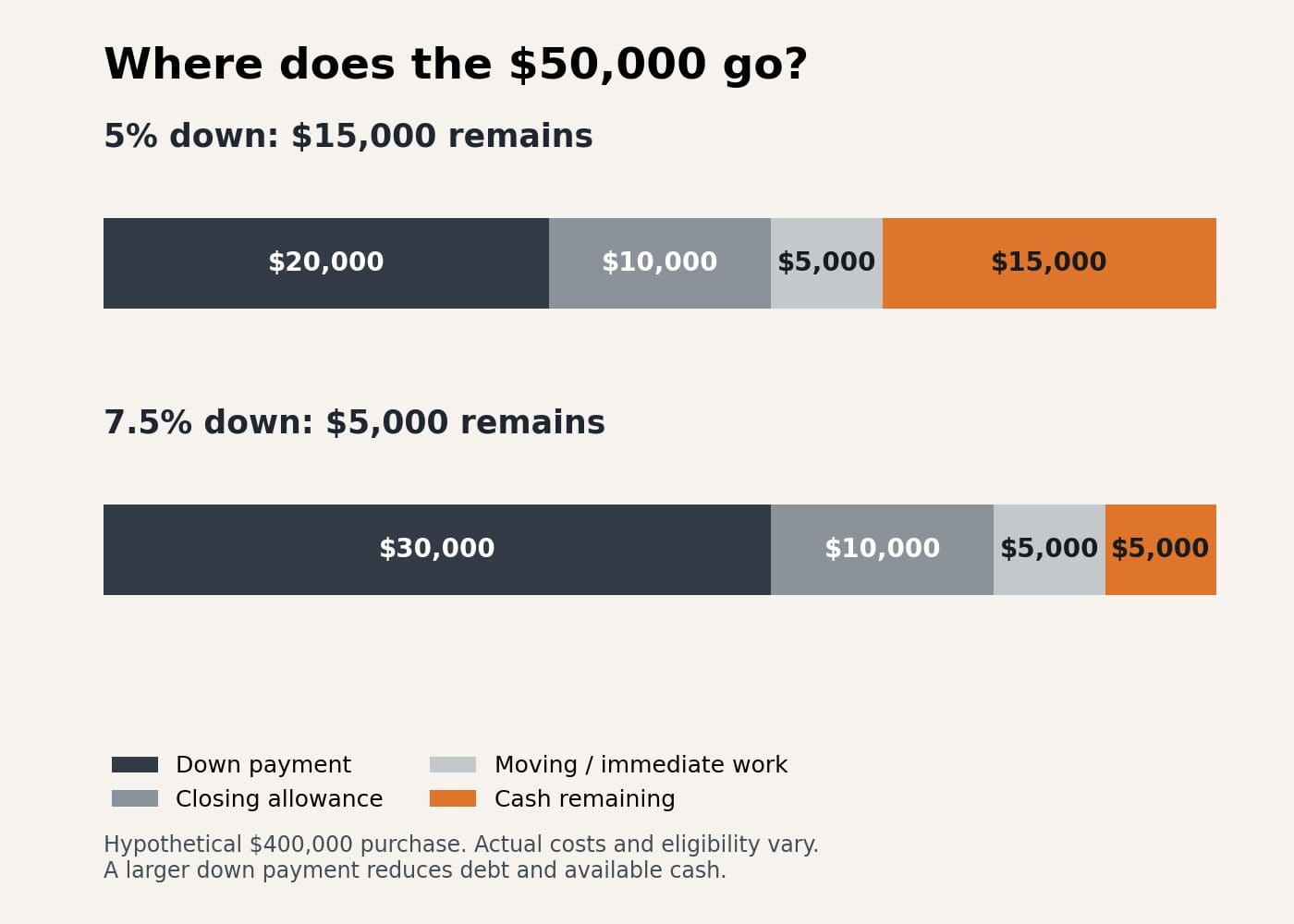
Cash remaining is not automatically an adequate cushion. Compare it with your essential monthly expenses, income stability and the property’s condition. In addition, identify how you would replenish it after a repair.
What does a $3,000 monthly budget actually cover?
When a buyer tells me $3,000 feels comfortable, I want to understand what that number includes. Is it the mortgage payment, or everything they expect to spend on housing? That distinction can change the search.
First, include principal and interest, property taxes, homeowners insurance and any mortgage insurance in the payment estimate. Then add HOA dues, utilities and maintenance where applicable. Avoid counting an expense twice.
The following is a hypothetical household budget, not a mortgage quote or the clients’ finances. The $3,000 payment is a chosen planning target, not a calculated payment for the $400,000 example. Income and spending figures are invented solely to demonstrate the arithmetic. This household has no HOA dues.
| Monthly item | Starting budget | Higher-cost test |
|---|---|---|
| Take-home income | $7,000 | $7,000 |
| Mortgage payment including taxes and insurance* | $3,000 | $3,250 |
| Utilities | $250 | $300 |
| Maintenance savings | $300 | $300 |
| Other living expenses and debt payments | $2,200 | $2,500 |
| Other planned savings | $700 | $700 |
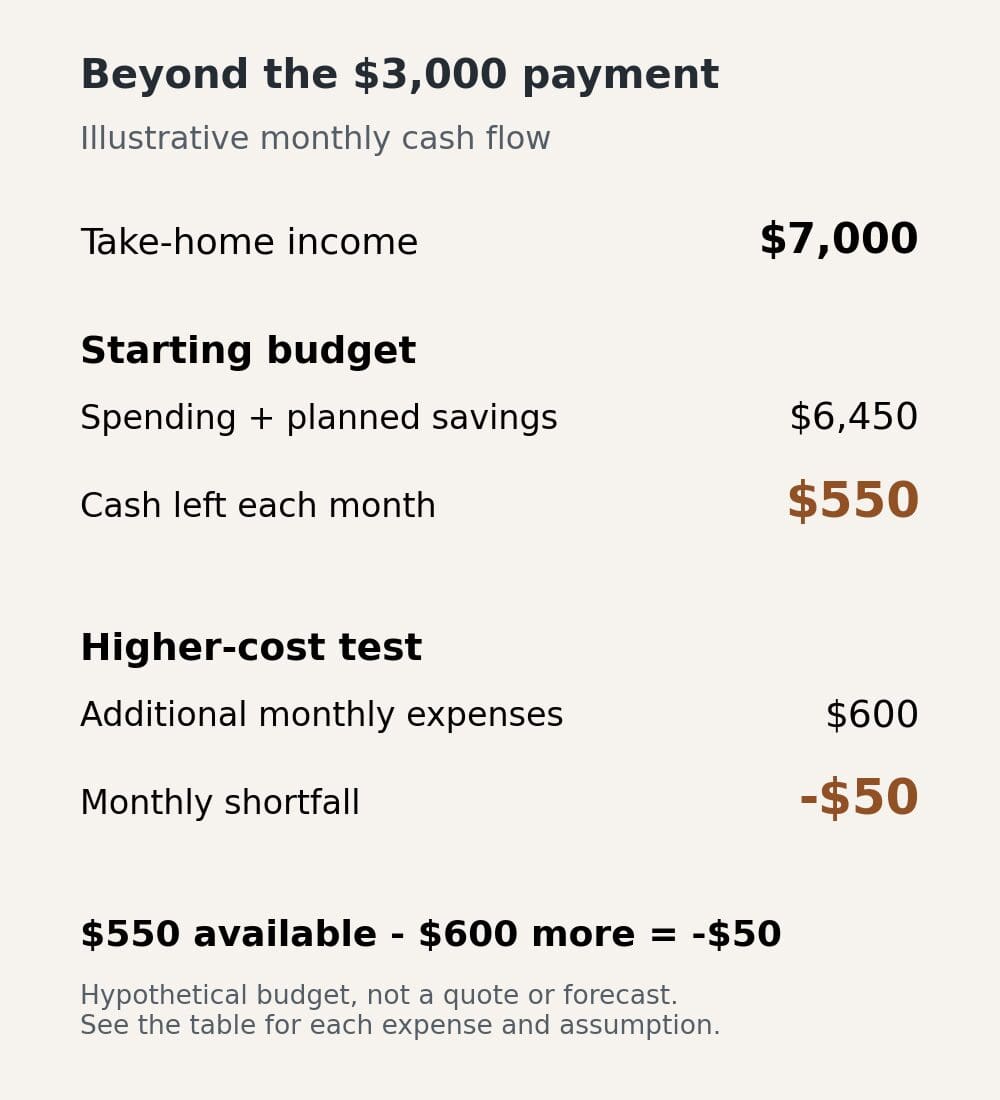
| Unallocated monthly cash | $550 | -$50 |
*Includes any applicable mortgage insurance. The $250 increase tests higher escrow costs, not an assumed interest-rate change. These are selected stress-test amounts, not forecasts or recommended spending levels.
The starting ownership budget totals $3,550 with utilities and maintenance savings. Meanwhile, the higher-cost test consumes another $600 across housing and household spending. Without adjustments, that changes $550 of breathing room into a $50 shortfall.
Qualification and comfort answer different questions
A lender’s debt-to-income ratio compares qualifying debt payments with qualifying income, generally before taxes. However, it does not capture every household expense or savings goal. A higher approval amount gives us something to evaluate; it does not mean you should spend it.
Strong income and limited debt can make qualification look comfortable on paper. Even so, a household without car payments or revolving credit-card debt still has groceries, student loans, retirement goals and future expenses. I would not treat unused borrowing capacity as a reason to stretch the budget.
Test today’s income before depending on tomorrow’s job
If a spouse plans to start working after a move to Denver, compare two budgets: one using current take-home income and another after the job starts. Also account for any new commuting, childcare or benefit costs. Expected salary is not spendable cash today.
That second income may help rebuild reserves or create flexibility. However, first ask what happens if the start date slips. Keep the payment comfort target in view instead of automatically raising it.
Also, a fixed interest rate does not freeze taxes or insurance. The CFPB explains how escrow changes can affect payments. For a Denver-area home, obtain an address-specific insurance quote, review the deductible and check tax and HOA information.
Before shopping at your maximum, try saving the difference between your current housing cost and the proposed ownership budget. Then test a repair or income interruption. Could you handle it without relying on credit cards, a raise or a future refinance?
If you want help connecting those numbers, let’s build your homebuying affordability plan.
Compare a smaller down payment with keeping cash
Keeping more money in the bank has value, especially when you are taking responsibility for a property’s upkeep. On the other hand, a larger down payment can reduce the amount borrowed and may improve financing costs.
Therefore, ask for written options using the same property, loan type and pricing date. Compare the full payment, fees, mortgage insurance and cash remaining. Do not assume an extra $10,000 down buys a particular rate improvement or eliminates mortgage insurance.
Also distinguish cash reserves from home equity. Equity contributes to your financial position, but accessing it later can require selling or qualifying for new financing. Cash in an accessible savings account serves a different purpose.
Our Colorado homebuyer resources can help you organize those choices before touring homes.
Negotiate for the financial outcome you need
A lower purchase price deserves consideration. So does a seller credit toward eligible costs. Compare both with your agent and mortgage professional before deciding what to request.
| Option | Potential benefit | Tradeoff to examine |
|---|---|---|
| Lower purchase price | Lower acquisition cost and potentially less debt. | Recalculate payment and cash needed using the actual down payment. |
| Closing-cost credit | Preserve savings by covering eligible expenses. | Program limits, available costs and the seller’s terms. |
| Permanent rate buydown | Pay points for a lower rate. | Upfront cost versus benefit over your loan timeline. |
| Temporary buydown | Subsidize early payments. | Whether the full payment fits after the subsidy ends. |
For example, an eligible $8,000 seller credit covering costs already included in the first scenario could leave $23,000 instead of $15,000 after the planned expenses. This assumes the same purchase price and loan terms, no offsetting charges, and sufficient eligible costs. It is not unrestricted cash back or a guaranteed negotiation outcome.
The CFPB recommends comparing points over different possible loan timelines. Similarly, evaluate a temporary subsidy separately from long-term affordability; FHFA’s explanation shows how the subsidy pays part of the payment until it ends.
Our guides to negotiating with an experienced buyer’s agent and comparing the full cost of buying explore that coordination.
Plan for a home you may keep longer than expected
Even a carefully considered purchase can become stressful when life changes. That does not automatically mean the buyer chose badly. However, selling involves costs, and the market may not support the price you need when you want to leave.
Likewise, refinancing depends on future pricing, eligibility and costs. Test whether the purchase works if you keep the current mortgage longer than planned. Consider the property’s likely repairs, space needs and ongoing expenses over that period.
If the plan leaves too little room, you can adjust the price range, property condition, down payment or timing. Continuing to rent while strengthening your finances can be a deliberate choice.
Bring your real budget to the conversation
Bring your savings balance, income information, debt payments, current housing costs and a realistic spending summary. Include the amount you want untouched after closing and any upcoming expenses you already know about.
From there, we can compare options around your priorities. The goal is a home you can enjoy while continuing to build financial stability.
Let’s build your homebuying affordability plan. Before deciding how much house to buy, let’s examine what ownership would mean for your life after closing.
Educational information, not a commitment to lend or individualized financial or tax advice. Examples are hypothetical. Approval, rates, costs, mortgage insurance and seller-credit eligibility depend on the borrower, property, loan program and underwriting. Mortgage Maestro Group | Maestro LLC | NMLS #1838215 | Equal Housing Opportunity.