
Buying your next home starts with deciding how the move will work financially, before a property captures your attention. Compare the purchase, any sale, renovation spending and the cash you want available afterward. Then evaluate homes against that plan.
One pattern I see at Mortgage Maestro Group is experienced homeowners calling when they have found the replacement home. They know how to buy. However, this purchase may involve equity, rental properties, improvements and timing decisions they did not face the first time.
In recent consultations, I spoke with buyers who had already sold and held cash, and others whose wealth remained in their current home. The same question connected both conversations: how do we make the next move without sacrificing financial flexibility?
The examples below are hypothetical planning exercises informed by those discussions. Amounts and circumstances do not reproduce an individual client’s finances.
Buying your next home: plan before the offer
Start with the household’s comfortable payment, available cash and preferred moving sequence. Also identify what would change the answer: a delayed sale, uncertain income, repairs or a longer overlap between homes.
Qualification and comfort deserve separate conversations. In my consultations, I ask about income and expenses over the next several years. A household may qualify and still dislike what the payment leaves for everyday life.
For a Denver buyer targeting a particular neighborhood, the next suitable listing may arrive before the current home sells. Early planning helps you evaluate that opportunity without making every financial decision under an offer deadline.
Planning a move? Let’s map out your financing before you make an offer.
Buying your next home: decide how much cash to use
Consider buyers with $250,000 available and a hypothetical $750,000 purchase needing improvements. That money must cover more than the down payment.
The CFPB’s down-payment planning guidance recommends allowing for renovations, other goals and an emergency cushion before calculating available closing funds.
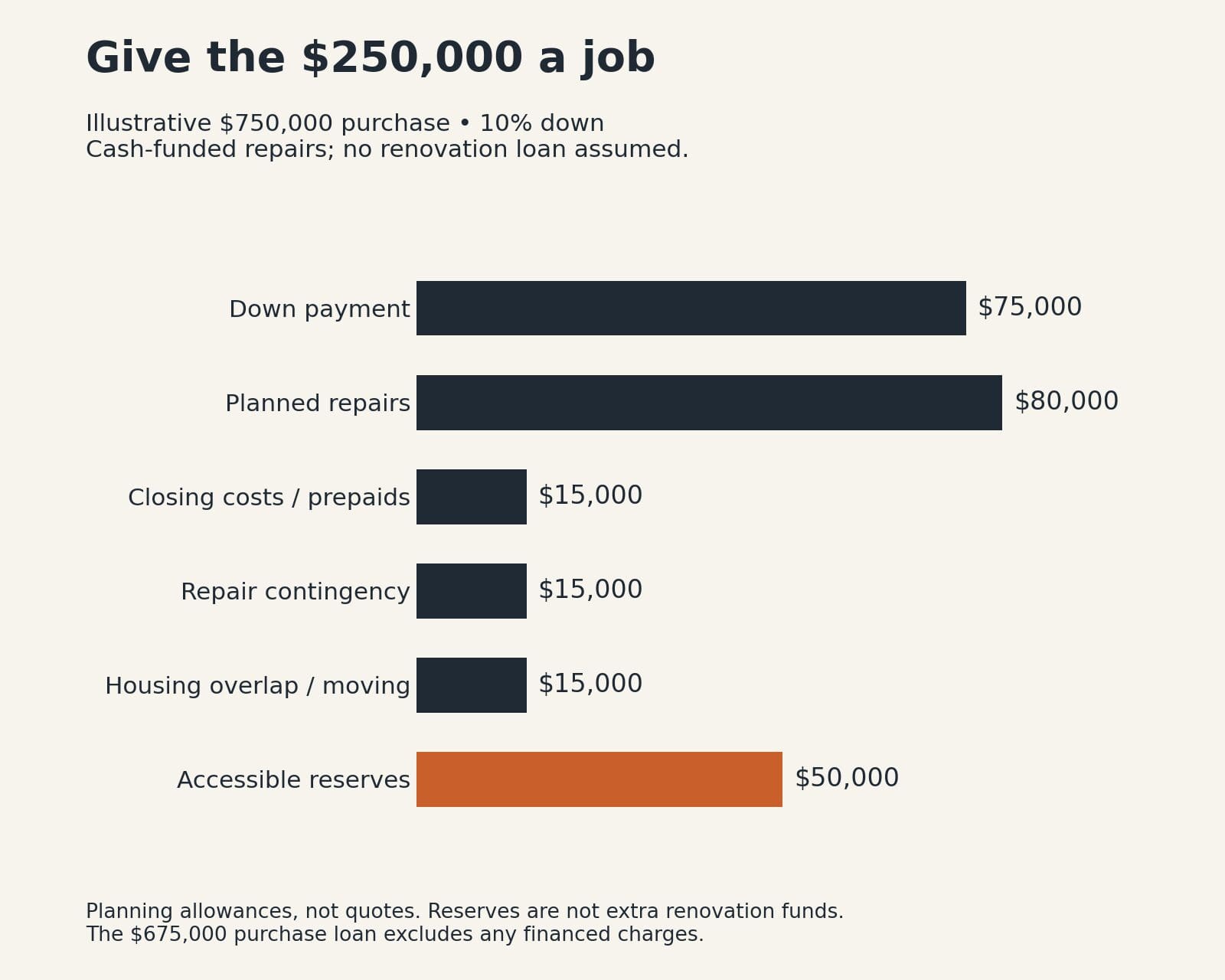
| Use of cash | Amount |
|---|---|
| 10% down payment | $75,000 |
| Planned repairs | $80,000 |
| Closing costs and prepaids | $15,000 |
| Repair contingency | $15,000 |
| Housing overlap and moving | $15,000 |
| Accessible reserves | $50,000 |
| Total | $250,000 |
These allowances produce a $675,000 purchase loan before any financed charges. However, increasing the down payment to 20% would require another $75,000. Keeping everything else unchanged would create a $75,000 cash shortfall.
A smaller down payment preserves cash but increases borrowing. Therefore, compare the payment, interest, fees and any mortgage insurance alongside the money remaining. The larger down payment is useful only if the entire plan still works.
When the right neighborhood means buying a project
An outdated kitchen and an unresolved structural concern require different decisions. Before relying on a renovation budget, obtain the appropriate inspections, specialist evaluations and written estimates. The appraisal does not replace that investigation.
When buying your next home with a renovation in mind, separate required repairs from improvements that can wait. Confirm whether the property qualifies for the proposed loan in its current condition; do not assume cash available after closing solves a pre-closing condition.
| Structure | Potential fit | What to compare |
|---|---|---|
| Purchase loan plus cash repairs | Property qualifies; cash covers the project | Larger loan with less down, reserves and contractor risk |
| Renovation mortgage | Eligible purchase and repairs financed together | Full fees, rate, approved scope, draws and completion rules |
| Phase optional improvements | Required repairs addressed; remaining work can wait | Future costs, household disruption and realistic savings |
For example, Fannie Mae’s HomeStyle Renovation combines eligible improvements and the mortgage into one loan. Program and lender requirements still apply. Neither cash-funded work nor renovation financing automatically costs less.
I would also ask whether you want to manage the project. Temporary housing, contractor coordination and uncertainty belong in the decision. Review our purchase and renovation loan options as a starting point for comparing structures.
Could a $50,000 reserve support the transition?
Buying your next home with cash left in reserve may also allow planned transfers toward monthly housing expenses. In the example above, suppose the buyers keep the $50,000 accessible, protect a $25,000 minimum balance and transfer $500 monthly for three years.
They would withdraw $18,000 and retain $32,000 before interest. The contractual mortgage payment does not decrease; their savings fund part of it.
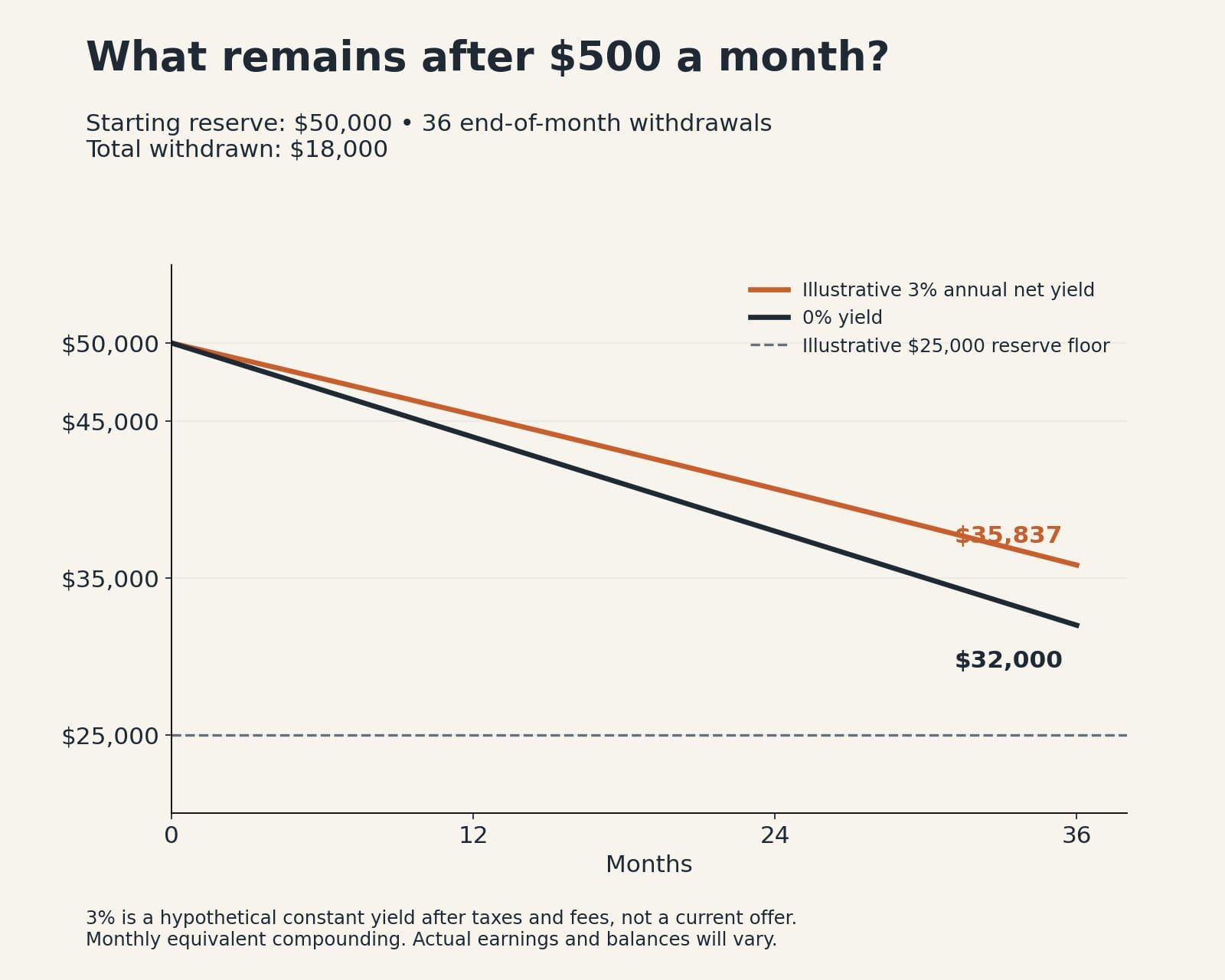
| Year | 0% yield | Illustrative 3% net yield |
|---|---|---|
| 0 | $50,000 | $50,000 |
| 1 | $44,000 | $45,418 |
| 2 | $38,000 | $40,698 |
| 3 | $32,000 | $35,837 |
Assumptions: $500 withdrawn at each month-end; 3% constant annual effective yield after taxes and fees, compounded at its monthly equivalent. This is a sensitivity example, not an available account quote or promised return.
For near-term spending, prioritize access and principal protection. An insured savings or money market deposit account differs from a money market mutual fund. Confirm coverage, withdrawal terms and account risks.
If established income later rises enough, the transfers could stop, leaving funds for future improvements or investing. Nevertheless, test the plan with flat income and no interest earnings. Review it regularly and set a stop point before reserves become depleted.
Also compare after-tax earnings with the cost of additional borrowing. Keeping cash may cost more while providing flexibility. The reserve cannot simultaneously fund unlimited renovations, emergencies and monthly transfers.
Buying before selling requires a second budget
For buyers who still own their home, equity is not yet spendable cash. A home equity line of credit, or HELOC, or a bridge arrangement may help fund a purchase, subject to eligibility and terms. Selling first remains another option.
Before listing or relying on either product, confirm access, qualification and the effect of plans to sell. Our bridge financing overview introduces that conversation. Request written terms rather than assuming every buy-before-you-sell program works alike.
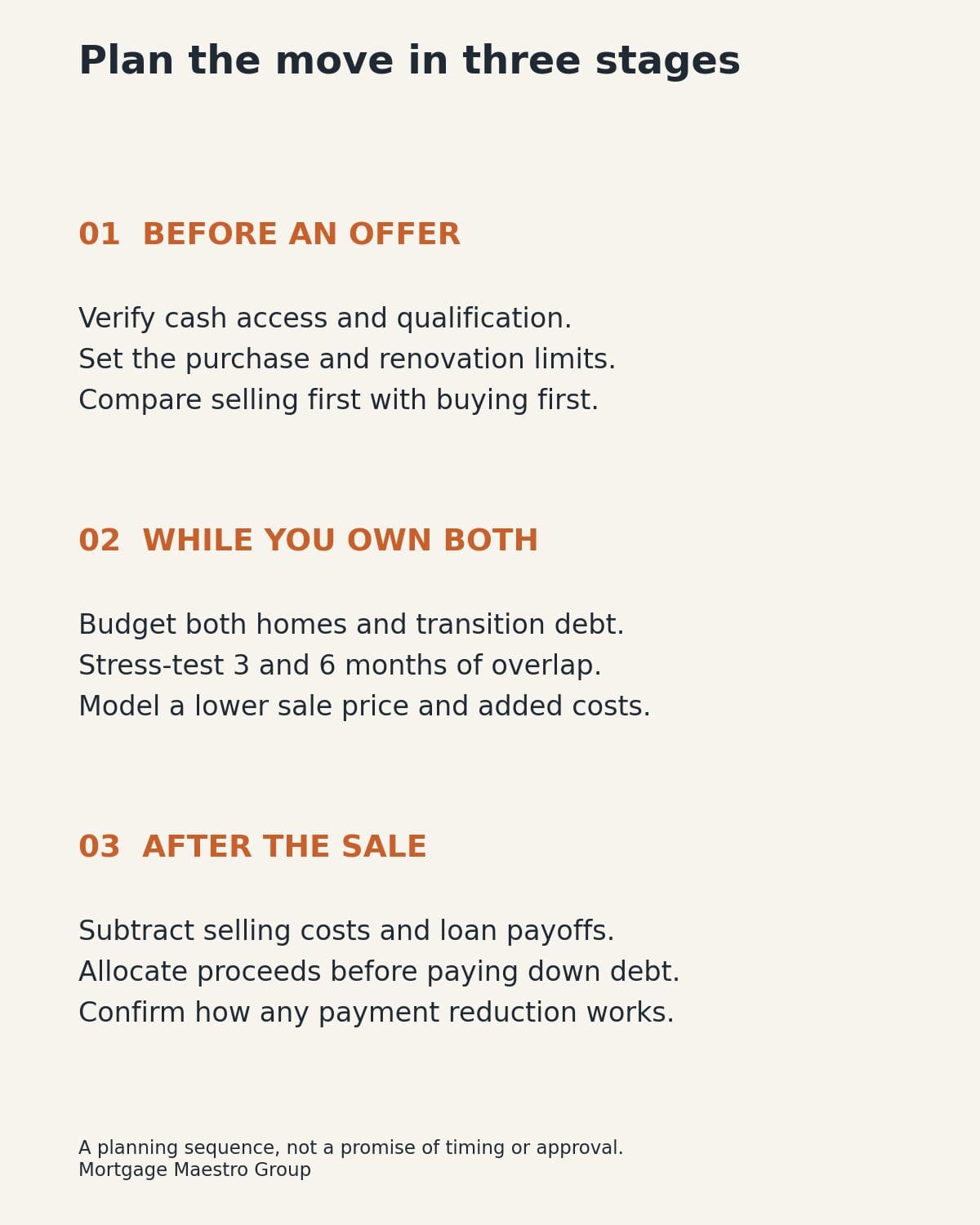
Build a budget for both homes, transition financing, insurance, taxes, utilities and moving costs. Then test three and six months of overlap and a lower sale price. Subtract selling costs and all required payoffs before treating proceeds as available.
According to the CFPB’s HELOC guidance, these lines usually have variable rates, and access can be restricted in certain circumstances. Borrowing to cover payments adds debt and interest; it is different from using existing savings.
Confirm what happens after the sale
If you plan to apply proceeds to the new mortgage, ask how that affects the required payment. A principal reduction alone does not necessarily reduce it.
A mortgage recast recalculates payments after a substantial principal reduction. Confirm eligibility, minimums, fees and timing with the specific lender or servicer before choosing the loan. Do not assume a future refinance will be available or beneficial.
Before buying your next home, bring the plan to us
Bring mortgage statements, available-funds information, income documentation, a realistic sale estimate and any repair bids. Also bring the monthly payment you want to live with and the cash balance you want to protect.
As an independent mortgage broker, business owner and real-estate investor, I want to understand those priorities before we choose a product. A desirable home should fit a financial plan that still makes sense after moving day.
Let’s map out your financing before you make an offer. We can compare the buying sequence, renovation funding and reserves for your next home.
General education, not individualized financial, investment or tax advice. Illustrations are not loan offers or approval commitments. Terms depend on borrower, property, program and lender review. Mortgage Maestro Group, operated by Maestro LLC. NMLS #1838215. Equal Housing Opportunity.