

To compare VA loan costs, review the borrowing costs, how the loan fits your plans and the loan officer’s experience with your situation. For example, a referral helps you find that professional. Then, the written offer and reasoning behind it help you decide.
That distinction matters when you have strong credit, meaningful savings or an existing VA-financed home you intend to keep. As a Navy Veteran, mortgage broker and property investor, I want to understand what you are trying to accomplish beyond closing this purchase.
A recommendation is a starting point
Professional memberships, reviews and referrals can provide useful information. However, none substitutes for evaluating your financing.
For example, Vetted VA publishes membership fees alongside training, testing and service requirements, with progression before directory placement. For that reason, those standards deserve fair recognition. Still, membership does not prove that a particular quote offers the lowest borrowing cost.
Likewise, review Mortgage Maestro Group just as carefully. Being veteran-owned does not automatically make our offer better. Therefore, we should explain the pricing and show how the loan serves your goals.
Compare VA loan costs beyond the interest rate
A lower rate can reduce your payment. However, purchasing that rate may require substantial upfront money. Discount points are prepaid interest used to obtain a lower rate; one point equals 1% of the loan. In contrast, an origination fee is a separate charge for arranging the loan.
An $850,000 Denver purchase
Our illustration assumes a 780 credit score, an $850,000 primary-residence purchase and loan, sufficient entitlement for zero down, and verified funding-fee exemption.
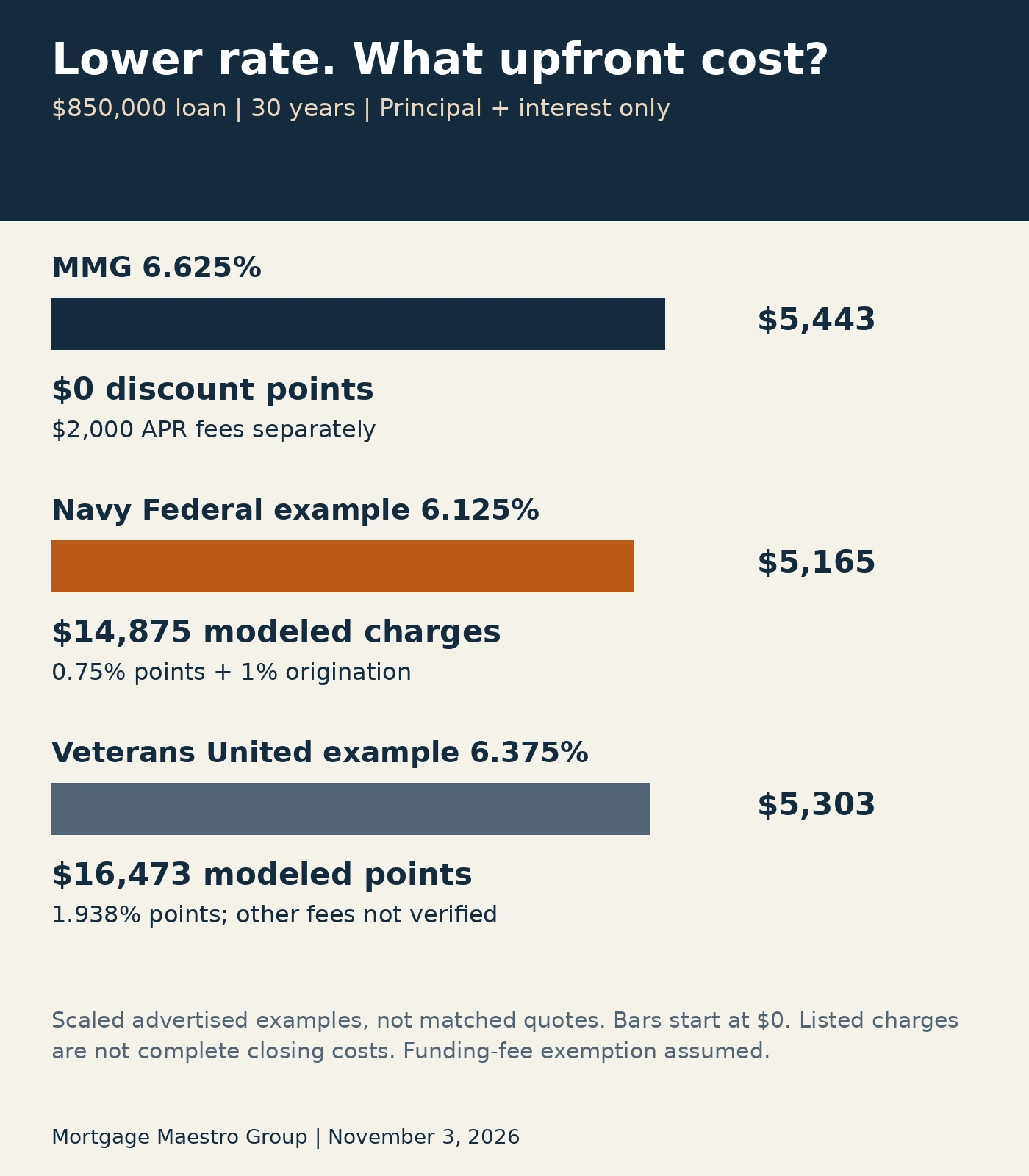
Mortgage Maestro’s November 3, 2026 baseline is 6.625% interest, approximately 6.648% APR, with no discount points, $2,000 in APR finance charges and a 30-day lock. That produces 360 monthly principal-and-interest payments of approximately $5,442.64. Taxes, insurance and HOA charges are additional.
The following scales published percentages to $850,000. However, these are examples to help you compare, not competing Loan Estimates for this borrower.
| Illustrated structure | Monthly principal + interest | Specified charges |
|---|---|---|
| MMG, 6.625% | $5,442.64 | $0 points; $2,000 APR fees |
| Navy Federal advertised rate, 6.125% | $5,164.69 | $14,875 modeled points/origination |
| Veterans United advertised rate, 6.375% | $5,302.89 | $16,473 modeled points |
Navy Federal’s published example disclosed 0.750 discount points plus 1% origination, with 6.584% APR. Veterans United disclosed 1.938 discount points and 6.855% APR. Their loan amounts, locks and funding-fee assumptions differ; those APRs do not apply to our scaled example.
We also checked Wells Fargo. Its retrieved current page did not expose a numerical VA quote, so we have not substituted an outdated rate. U.S. Bank’s retrieved VA rate fields were also unavailable.
Calculate break-even before buying savings
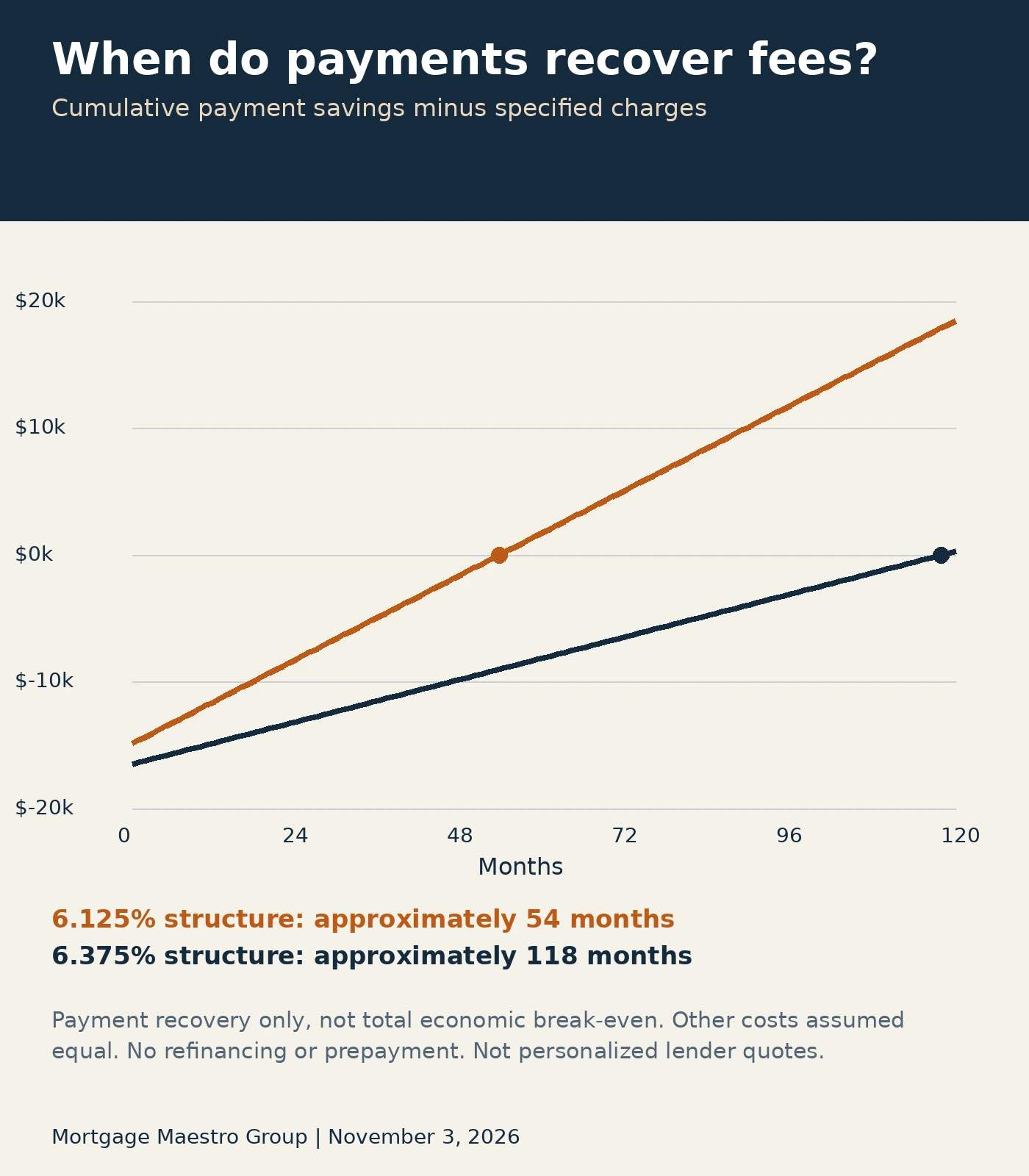
Additional upfront cost divided by monthly savings gives a simple payment break-even. Using the specified charges and assuming other costs are equal, $14,875 divided by $277.95 is approximately 54 months. For the Veterans United structure, $16,473 divided by $139.75 is approximately 118 months.
However, these are only initial estimates of how long it takes to recover the cost. For a full comparison, use the difference in all fees and credits without counting origination twice. Therefore, your likely mortgage holding period matters more than an advertised rate alone.
What if that money reduces your mortgage instead?
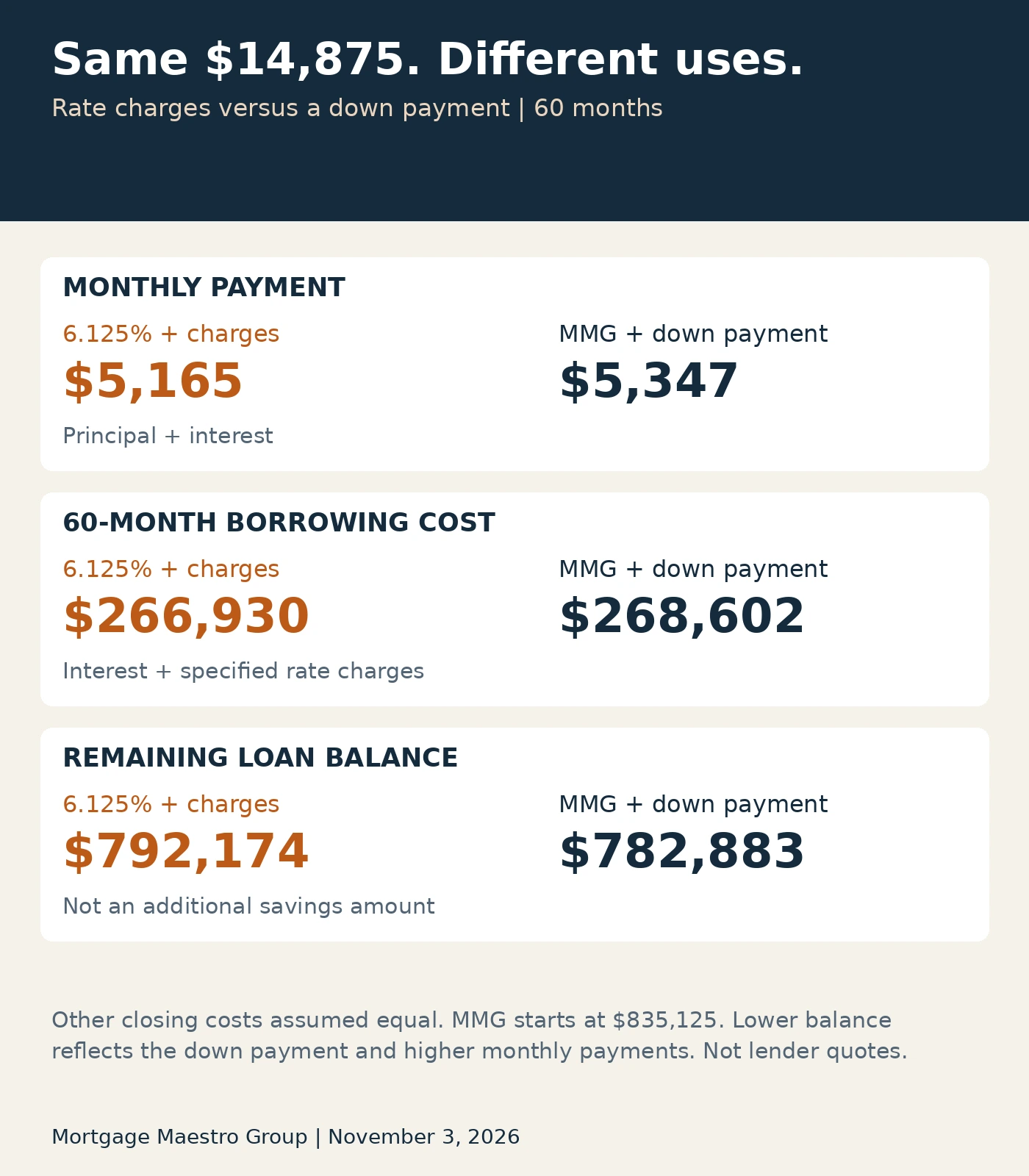
Put the same $14,875 toward the purchase with MMG’s no-points option, and the starting mortgage becomes $835,125. Here is the result after 60 payments:
| Measure | 6.125% with charges | MMG 6.625% with down payment |
|---|---|---|
| Monthly principal + interest | $5,164.69 | $5,347.40 |
| Interest paid | $252,055 | $268,602 |
| Interest + specified rate charges | $266,930 | $268,602 |
| Remaining balance | $792,174 | $782,883 |
Assuming equal other costs, the lower-rate structure’s five-year advantage is approximately $1,672. Meanwhile, MMG’s balance is approximately $9,291 lower. That balance difference is not extra savings to add: the MMG borrower also makes higher monthly payments. In contrast, a down payment reduces debt rather than becoming a borrowing expense.
For comparison, without the additional down payment, the modeled 6.375% loan’s five-year interest reduction is about $10,673, below its $16,473 points by approximately $5,800. In other words, no option wins every time.
Have a VA Loan Estimate in hand? We can compare fees and balances against your timeline. Request a VA loan comparison.
How a future VA IRRRL affects the decision
An Interest Rate Reduction Refinance Loan, or IRRRL, may help eligible VA borrowers reduce their rate or move from an adjustable rate to a fixed rate.
However, refinancing before recovering purchased points can reduce their benefit. Future rates, eligibility and closing costs remain uncertain. Therefore, compare keeping the original mortgage with refinancing if a worthwhile opportunity develops.
A second VA purchase tests the lender’s expertise
You may be able to retain an existing VA-financed property while using remaining entitlement for another qualifying primary residence. However, this does not mean financing a vacation home.
Understand remaining or bonus entitlement
Your Certificate of Eligibility, or COE, identifies entitlement charged to prior loans. Without full entitlement, the starting calculation is 25% of the applicable one-unit county limit minus entitlement already charged. Your lender then evaluates the proposed transaction and any required down payment.
Funding-fee exemption does not restore entitlement. Neither does paying down an existing mortgage automatically replenish it dollar for dollar. Review VA’s entitlement explanation and our VA loan guide.
Ask for evidence before making an offer
Request the written entitlement calculation, review of both housing obligations, treatment of potential rental income and required reserves. Also ask what underwriting has actually reviewed. Even with strong credit, you still need answers to those questions.
When a five-year VA ARM deserves consideration
A five-year adjustable-rate mortgage fixes its initial rate for five years. Afterward, the index, margin and contractual caps determine adjustments. Therefore, consider it only if both the initial value and later payment risk fit your finances.
Could seller credits help?
A 3% seller credit on $850,000 equals $25,500. Depending on pricing and eligible expenses, credits may help fund points and closing costs. A hypothetical 5.25% initial rate produces approximately $4,693.73 monthly principal and interest on an $850,000, 30-year loan, $748.91 below the fixed-rate illustration during the initial period.
However, that credit does not automatically buy 5.25%. Compare its use toward an ARM, a fixed-rate buydown or other expenses. Subsequent ARM rates and payments can increase; refinancing is not guaranteed.
Watch: How a VA ARM changes payments and loan balances. In this walkthrough, I compare a fixed-rate mortgage with a five-year ARM, including applying payment savings toward principal. Its historical example is separate from this article’s pricing. For that reason, review the loan assuming you might keep it after adjustment.
VA’s handbook permits an initial adjustment up to two percentage points for hybrids fixed five years or longer; a product may have tighter caps. Do not assume the video’s 1% example applies universally.
Who qualifies for funding-fee exemption?
Receiving VA compensation for a service-connected disability is one qualifying circumstance. VA lists other qualifying categories, including certain surviving spouses. Therefore, have the lender confirm your status. However, exemption removes the funding fee, not all closing costs.
Compare VA loan costs with a second opinion
Compare current offers using matching loan amounts, lock periods and funding-fee treatment. Our guide to when to shop mortgage lenders and rate-lock explanation can help.
Buying your next home or keeping an existing VA-financed property? Bring your Loan Estimate, COE and current mortgage statement. Schedule your VA financing strategy consultation.
Educational illustrations dated November 3, 2026; not a commitment to lend. Eligibility, pricing and underwriting apply. Competitor examples are not personalized quotes. Payments exclude taxes, insurance and HOA charges. ARM payments can increase. Mortgage Maestro Group is an independent mortgage broker. NMLS 1838215. Equal Housing Opportunity.