

Buying your first rental while self-employed starts with a decision that changes the financing: will you live in the property or rent out every unit? Your answer shapes the income review, cash needed, loan options, and risk you take. In Denver’s late-2026 market, it also helps you recognize which year-end opportunities actually fit your finances.
You may have a profitable business, money from an earlier home sale, and experience renovating. Even so, those strengths do not automatically point to one mortgage. Before you make an offer, separate three questions: what can you qualify for, what can you comfortably carry, and what investment are you trying to build?
I’m Ray Williams, owner of Mortgage Maestro Group, a self-employed business owner and rental-property investor. In a recent consultation, a prospective investor wanted to explore several paths before choosing a property. The useful part of that conversation was the order of the decisions. We started with income, available capital, and intended occupancy, then discussed financing.
This guide draws on that discussion without reproducing the borrower’s personal circumstances. All financial examples below are hypothetical, independently constructed, and do not describe an approval or completed transaction.
Why the end of 2026 may create opportunities for prepared buyers
Denver’s September market report showed 13,567 active listings and 4.76 months of inventory. However, the market was uneven: attached homes had more inventory relative to sales than the overall market. That creates room for selective negotiation, rather than a reason to assume every property is a bargain. These are broad residential figures, not a dedicated duplex or fourplex study. Source: DMAR’s September 2026 report, released October 3.
Meanwhile, Freddie Mac reported a national 30-year fixed average of 7.32% on October 22, compared with 6.19% a year earlier. That conventional market benchmark is not a quote for your investment, FHA, or bank-statement loan. It does explain why a purchase needs to work at available financing terms, without assuming rates will fall. Source: Freddie Mac.
A seller’s deadline can matter as much as the asking price
Some sellers want to finish a relocation, stop carrying a vacant property, or simplify their finances before another year begins. Others may be coordinating a sale with their tax adviser. Therefore, your agent should ask what the seller needs and determine whether timing, certainty, price, or an approved concession would help reach an agreement.
A seller who bought at a higher price may feel pressure to sell. Yet that same seller may have limited equity after loan payoff and selling expenses. Urgency does not necessarily create room for a large credit. Also, a home selling below its earlier purchase price does not, by itself, prove that its owner owes more than it is worth.
More inventory gives you room to inspect quality
Additional choices can help you compare a renovated property with one that needs substantial work. However, fresh finishes do not establish good construction, legal unit count, or dependable rental demand. Review permits, roof age, major systems, existing leases, and realistic repair bids before deciding that a higher-priced, improved property offers better value.
For example, paying more for documented repairs may preserve time and cash. Conversely, cosmetic improvements can hide deferred maintenance. My preference is to compare the total acquisition and operating plan, including the work you would inherit, before deciding which listing deserves an offer.
Tax timing belongs in the plan, not at the center of the purchase
A seller’s taxable event can influence their preferred closing date. Your own tax planning may also affect timing. However, buying a rental does not automatically erase unrelated taxable income, and a December closing does not automatically make the property eligible for that year’s rental depreciation.
The IRS generally ties the start of rental depreciation to when the property is ready and available for rent. A property that needs work into January may have a different placed-in-service date than its closing date. Ask your CPA to review the facts before you attach tax savings to an offer. Source: IRS Publication 527.
Buying your first rental while self-employed: choose how you will use it
House hacking usually means living in a property while renting part of it to help offset ownership costs. A duplex offers a straightforward example: you occupy one legal unit and rent the other. A dedicated rental, by contrast, is an investment property you do not occupy as your home.
Both can build a portfolio. However, they solve different problems. Living in one unit combines a housing decision with an investment decision. Buying a dedicated rental keeps your own housing separate, so you must budget for both commitments.
| Decision | Live in one unit | Rent every unit |
|---|---|---|
| Primary purpose | A home with rental income potential | A separate investment |
| Financing paths to investigate | Conventional, FHA, or eligible alternative documentation | Conventional investment financing or an eligible DSCR program |
| Cash planning | Purchase costs, household cushion, repairs, and landlord reserves | Investment costs plus your separate housing and household cushion |
| Lifestyle question | Are you comfortable living near tenants? | Who will manage the property and respond to repairs? |
| Main risk to test | Can you carry the property during a vacancy? | Does the rental budget work after all operating costs? |
Be accurate about occupancy from the beginning. Do not use an owner-occupied application for a property you already intend to operate solely as a rental. Likewise, a business-purpose DSCR loan is not a substitute for financing the home you plan to occupy.
Separate business income, sale proceeds, and available cash
Start with a traditional income review
Self-employment does not automatically require a bank-statement loan. First, review personal and applicable business tax returns, the current business picture, and allowable income adjustments. A correct analysis can produce a different result than simply reading the taxable-income line.
Fannie Mae’s guidance focuses on stable income and the business’s ability to keep generating and distributing funds. It also requires attention to business viability when business assets support the transaction. Therefore, a healthy account balance and a healthy recurring income stream answer different underwriting questions. Source: Fannie Mae’s self-employed borrower guidance.
For broader preparation, see our Colorado Self-Employed Mortgage Guide. This article focuses specifically on choosing and financing a first rental or owner-occupied small multifamily property.
A bank-statement loan evaluates deposits; it does not count every deposit as income
When traditional documentation does not fit, an eligible bank-statement program may offer another way to evaluate business cash flow. The lender reviews acceptable deposits, expenses, ownership, and business history under its own rules. Transfers, borrowed funds, and one-time proceeds do not become recurring business income simply because they appear in an account.
Consequently, compare the actual qualifying calculation alongside pricing, down payment, reserves, and property eligibility. Do not change your tax strategy solely to fit a mortgage before your mortgage adviser and CPA have compared the alternatives. Our bank-statement loan guide explains that review in more detail.
Money from a home sale may help with cash requirements
Documented sale proceeds may support a down payment or reserves. However, a single sale does not automatically establish ongoing qualifying income. Also, the cash received at closing is not necessarily the same amount as the taxable gain.
Capital-gains income has its own underwriting rules. For example, Fannie Mae requires a minimum two-year history for that income category. That is a separate analysis from tracing the proceeds of one home sale into an account. Source: Fannie Mae’s capital-gains income guidance.
Watch Ray explain self-employed mortgage planning:
Watch the self-employed mortgage video on YouTube.
FHA versus conventional financing for house hacking
Compare the full ownership cost and qualification requirements before choosing a smaller down payment. FHA and conventional financing can both deserve consideration for an eligible owner-occupied small multifamily property. However, mortgage insurance, rental-income treatment, reserves, and property standards can change the result.
| Issue | FHA | Fannie Mae conventional |
|---|---|---|
| Potential down payment | As low as 3.5% for eligible borrowers and properties | Eligible two-to-four-unit principal-residence purchases through Desktop Underwriter may allow 95% loan-to-value, equivalent to 5% down |
| Mortgage insurance | Upfront and ongoing premiums affect cost | Private mortgage insurance generally applies above 80% loan-to-value |
| Three or four units | Additional property self-sufficiency test | Evaluate under the applicable conventional rental-income and reserve rules |
| Rental income | Documentation and qualifying calculations apply | Documentation, borrower history, and qualifying calculations apply |
Sources: CFPB’s FHA overview, Fannie Mae’s eligibility matrix, and HUD Handbook 4000.1. These starting points depend on credit, loan limits, underwriting findings, property eligibility, and lender requirements. Cash needed also includes applicable costs, prepaids, and reserves.
Why a fourplex needs more analysis than a duplex
FHA applies a self-sufficiency test to three- and four-unit properties. The calculation uses appraiser-supported rents from all units, including the owner’s unit, with a vacancy and maintenance adjustment. The resulting amount must support the required housing-payment test.
That does not mean you can collect rent from the unit you occupy. Underwriting and household budgeting serve different purposes. Therefore, calculate your real out-of-pocket cost using the units you will actually rent and a realistic allowance for vacancies and repairs.
Watch Ray compare FHA and conventional house hacking:
Watch the house-hacking comparison on YouTube. Program guidance can change after a video’s recording; confirm the current rules for your transaction.
A DSCR loan does not replace an investment budget
DSCR stands for debt service coverage ratio. Many residential investor programs compare qualifying rent with a defined monthly property payment. However, lenders vary in the rent they accept, the expenses in their calculation, and the ratio they require. Conventional investment financing remains worth comparing when your documented personal income supports it.
Also, ask about reserves, first-time-investor eligibility, prepayment penalties, and refinancing restrictions. Lower personal-income documentation does not remove credit, asset, property, or occupancy requirements. A lender’s willingness to finance a property does not establish your expected profit.
Illustration: a 1.25 ratio can still produce negative cash flow
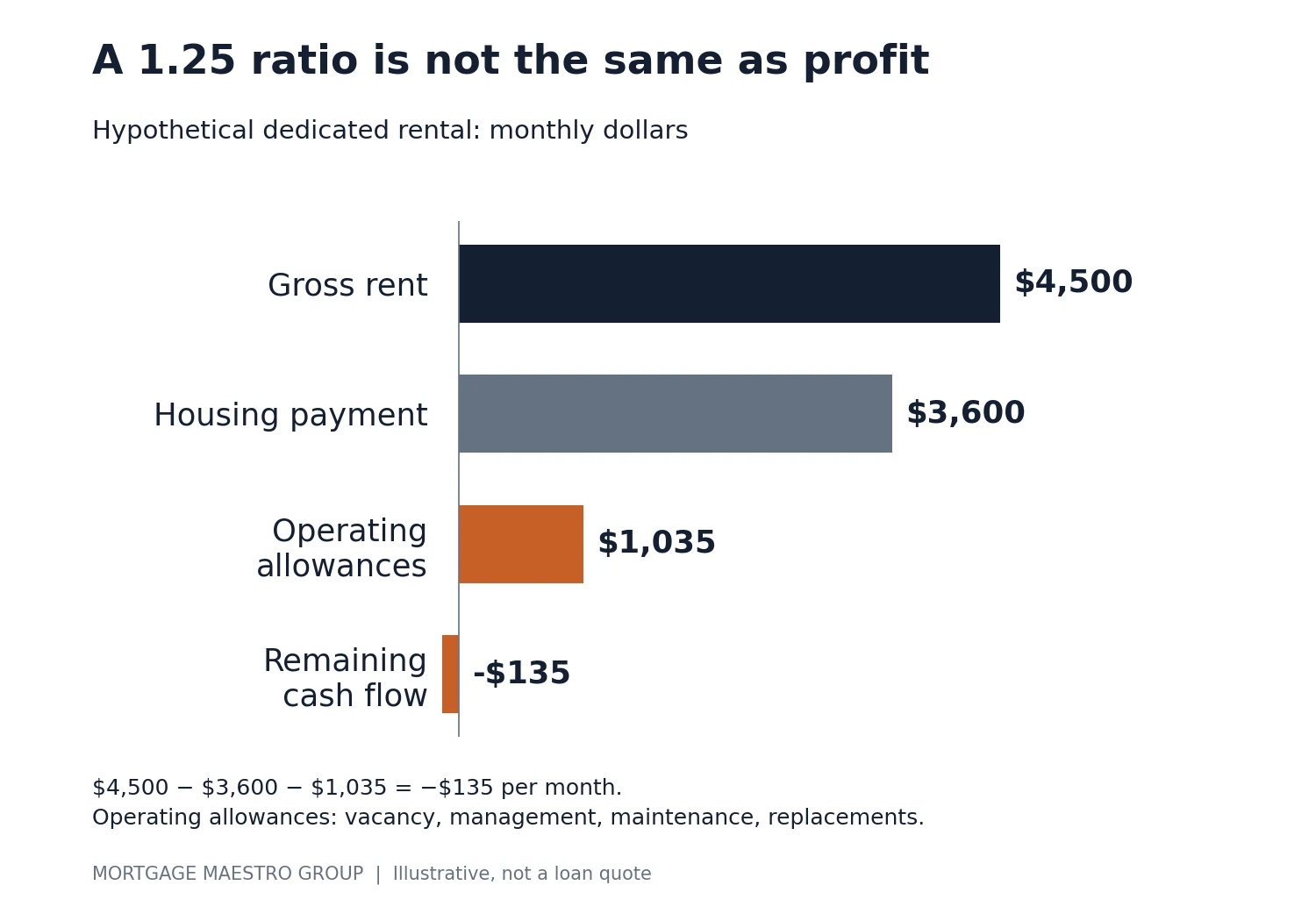
Assume a dedicated rental generates $4,500 per month and its all-in loan-related housing payment is $3,600, including principal, interest, taxes, insurance, and any association dues. For this simplified example, rent divided by that payment equals 1.25. These are invented budget inputs, not lender terms or a local rent estimate.
| Budget item | Base case | Lower-rent case |
|---|---|---|
| Gross scheduled rent | $4,500 | $4,200 |
| Housing payment | −$3,600 | −$3,600 |
| Vacancy allowance: 5% | −$225 | −$210 |
| Management allowance: 8% | −$360 | −$336 |
| Routine maintenance: 5% | −$225 | −$210 |
| Capital replacement allowance: 5% | −$225 | −$210 |
| Cash flow after these allowances | −$135 | −$366 |
| Simplified rent/payment ratio | 1.25 | 1.17, rounded |
All allowances use gross scheduled rent for transparent arithmetic; an actual manager may charge differently. The model excludes owner-paid utilities, leasing fees, extraordinary repairs, and income taxes. Consequently, those costs could make the result worse. Principal repayment may build equity, but it does not supply cash to pay a repair bill.
Self-management may reduce a cash expense, although your time still has value. Likewise, appreciation may help long-term returns, but it cannot be counted on to fund current operations. Decide whether you can comfortably support the investment before pursuing it.
Use seller concessions to protect the right part of your budget
A price reduction, a closing-cost credit, and a rate buydown have different effects. A lower price reduces the acquisition basis and can reduce financing needs. An eligible closing-cost credit can preserve your own cash. A permanent buydown changes the rate at an upfront cost, while a temporary buydown subsidizes early payments without changing the note rate.
Before negotiating, ask your mortgage adviser to calculate what the selected program permits and what you can actually use. For Fannie Mae loans, financing concessions cannot fund the down payment or directly satisfy reserve requirements. Its investment-property financing-concession cap is 2%; principal-residence limits vary with leverage. Source: Fannie Mae’s interested-party contribution rules.
Illustration: preserving $12,000 rather than spending every available dollar
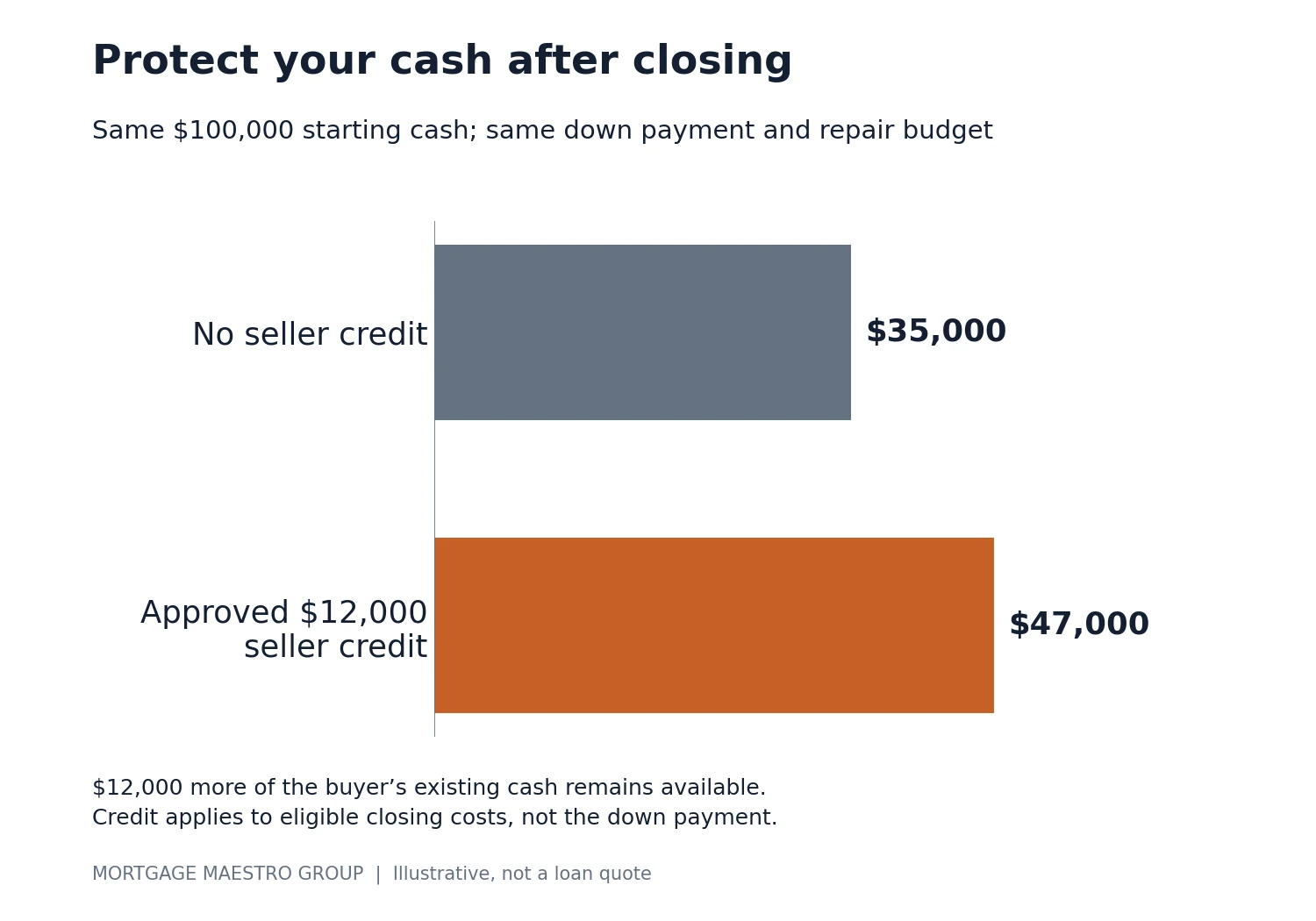
Consider a hypothetical $600,000 owner-occupied duplex purchase with $100,000 available, a $30,000 down payment, $15,000 of closing costs and prepaids, and a separate $20,000 repair budget. Assume the borrower qualifies independently and the lender approves a $12,000 seller credit toward eligible costs. Repairs must also fit the property and financing requirements.
| Item | No seller credit | $12,000 approved credit |
|---|---|---|
| Starting cash | $100,000 | $100,000 |
| Down payment | −$30,000 | −$30,000 |
| Buyer-paid closing costs/prepaids | −$15,000 | −$3,000 |
| Repair budget set aside | −$20,000 | −$20,000 |
| Remaining liquidity | $35,000 | $47,000 |
This is a cash-allocation example, not a loan offer or a total ownership-cost comparison. It omits monthly payments and mortgage insurance, which require a separately priced loan analysis. The seller must agree, the appraisal must support the transaction, and eligible costs must support the full credit.
Compare a buydown against keeping cash available
A permanent buydown may suit a longer holding period, but compare its cost with its payment benefit and your likely loan duration. Meanwhile, a temporary buydown can help near-term cash flow only if the full future payment remains manageable. Neither approach makes a future refinance certain.
For a business owner, liquidity also has a job: payroll, taxes, business opportunities, household expenses, and property repairs. Therefore, I would compare those needs before directing every available seller dollar toward a lower payment.
Plan for a hold before you plan for a refinance
The BRRRR strategy means buy, rehab, rent, refinance, repeat. It can sound predictable when every stage fits neatly into a spreadsheet. In practice, the next appraisal, construction schedule, rental income, and refinance terms can change.
Before buying, test whether you can hold the property longer than planned. Also, confirm how seasoning rules, maximum leverage, and any prepayment penalty could affect your exit. Borrowing renovation money on credit cards or a personal loan adds another payment and may affect qualification, so review that plan before taking on the debt.
If a transaction works only after an immediate cash-out refinance, I would want a documented fallback. That might mean more reserves, a smaller renovation, a different property, or waiting. A year-end opportunity remains an opportunity only when you can manage what happens after closing.
Prepare your financing before the year-end offer
Bring the documents that let us compare real options
Start with personal and applicable business returns, current business financials, available bank statements, a debt list, and documentation for significant asset proceeds. Then explain what cash must remain available for the business and household. The selected program determines the final document list and review period.
If you already have a property in mind, add the listing, legal unit information, leases, rental comparables, insurance quote, and repair estimates. Those details help connect financing to the property rather than treating prequalification as a stand-alone number.
Give each professional a clear assignment
Your agent should investigate comparable sales, rental evidence, condition, and seller priorities. Next, your mortgage adviser should compare eligible financing and concession structures. Your CPA should evaluate tax timing and consequences. Meanwhile, an inspector and qualified contractors can test the renovation assumptions.
Our role at Mortgage Maestro Group is to help connect those decisions. As an independent mortgage broker, we compare available financing paths with the way you earn income and intend to use the property. Sometimes the strongest next step is an offer; sometimes it is a preparation plan that protects your options.
Questions to resolve before choosing a property
Can I keep renting my own home and buy an investment property?
Potentially. Your current rent remains a real household expense, and eligibility varies by loan. Some investor programs also restrict first-time investors or borrowers who do not own a primary home. Check that combination before relying on a DSCR option.
Does a five-unit building use the same financing as a fourplex?
Generally, five or more residential units move into commercial multifamily financing. Therefore, do not assume the owner-occupied one-to-four-unit options discussed here apply to a five-unit property. Verify legal unit count early.
Should I close before December 31 if my CPA sees a tax benefit?
Only after comparing the expected benefit with the property’s price, financing, condition, and readiness for rental use. A tax benefit may improve a good plan, but a deadline can also encourage an expensive mistake. Coordinate the intended closing and placed-in-service dates with your CPA.
Build your first-property plan with Mortgage Maestro Group
If you are self-employed and considering a duplex, fourplex, or dedicated rental, let’s compare the paths before you commit to one. We can review how your income qualifies, what cash the purchase would use, and which financing structure fits your intended occupancy.
Schedule a first-investment strategy consultation. Bring your target budget, income structure, and any property you are considering so we can make the discussion specific.
Mortgage Maestro Group is an independent mortgage broker. NMLS #1838215. Equal Housing Opportunity. Educational information only; this is not a commitment to lend or individualized tax, legal, or investment advice. Approval, pricing, concessions, and program availability depend on borrower, property, lender, and current requirements. Consult your qualified tax adviser about your circumstances.