

If your HELOC is coming due, start with the agreement: is the draw period ending, is the payment changing, or is the entire balance due at maturity? Your next step could be repayment, a replacement equity loan, or a refinance. The right answer depends on the deadline, your income, and the cost of the complete plan.
At Mortgage Maestro Group, I start these conversations by separating the deadline from the financing decision. A homeowner may ask for a cash-out refinance when the underlying need is to resolve one or more equity loans. We should examine both before replacing a first mortgage that still serves them well.
I am Ray Williams, owner of Mortgage Maestro Group and an independent mortgage broker in Denver. Recent inquiries prompted this guide. The example below is hypothetical; it does not describe an identifiable client or a completed loan.
Your HELOC is coming due: which date matters?
A home equity line of credit has several dates worth understanding. During the draw period, your agreement may allow borrowing and repayment up to an approved limit. After that period ends, additional borrowing generally stops and repayment begins. Final maturity is the date by which you must satisfy the remaining obligation.
Those events can occur years apart. However, some agreements require a lump-sum payment when the draw period ends. The CFPB explains these repayment differences. Read your contract and ask the servicer for written confirmation of your dates, next payment, and any balloon balance.
Also check whether the rate remains variable, how often it adjusts, and whether a fixed-rate conversion exists. A conversion may improve predictability without extending the maturity date. Therefore, ask about both the payment and the payoff obligation.
A payment can rise even without a rate increase
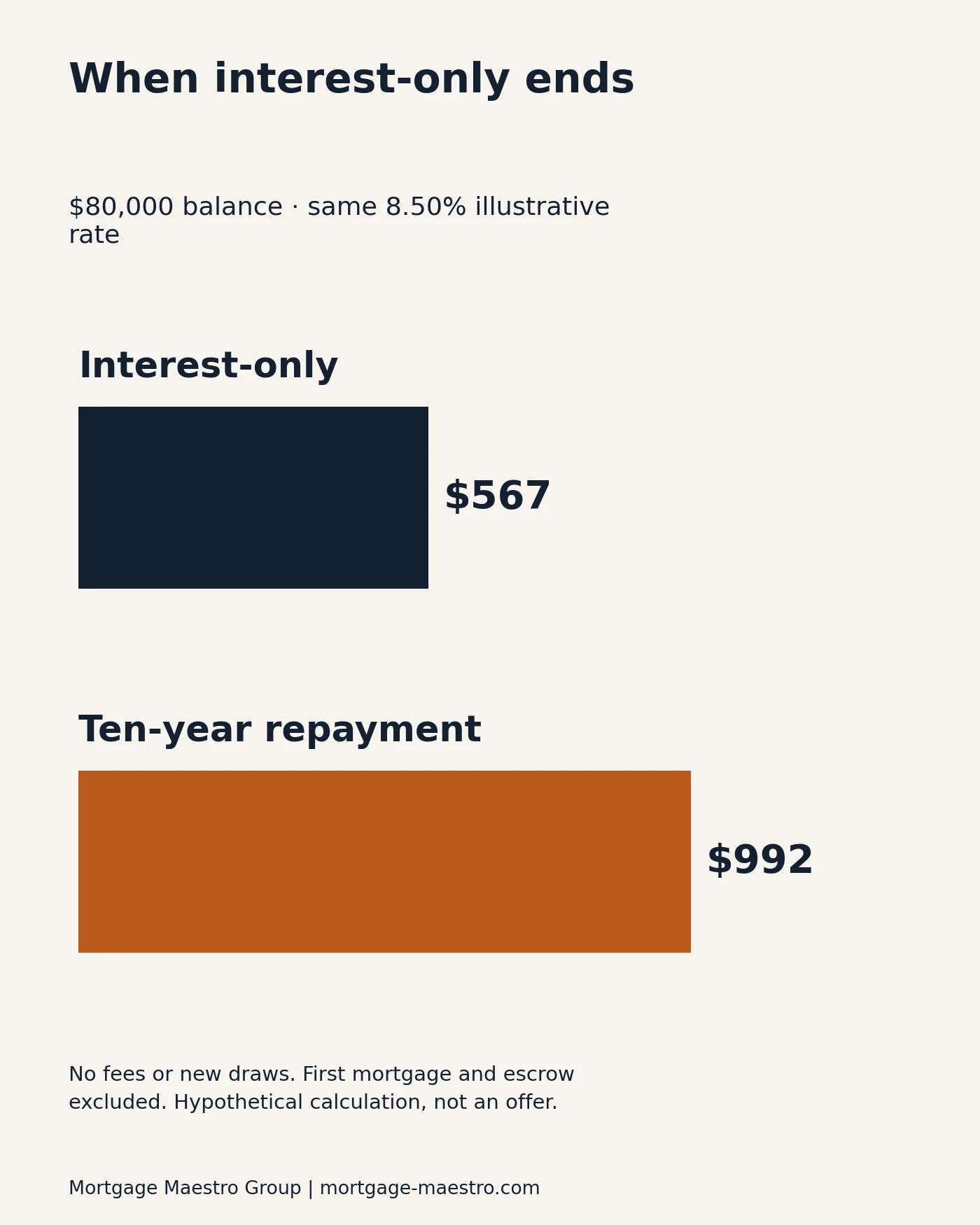
Consider an illustrative $80,000 balance. At an unchanged 8.50% annual interest rate, a monthly interest-only payment would be about $567. If the same balance begins amortizing over ten years at that rate, principal and interest would rise to about $992 per month.
| Illustrative arrangement | Monthly payment | What happens to principal? |
|---|---|---|
| Interest-only at 8.50% | $567 | The $80,000 balance remains if no principal is paid. |
| Ten-year amortization at 8.50% | $992 | Scheduled payments gradually repay the balance. |
The difference is approximately $425 monthly, or 75%. This calculation assumes monthly interest, no fees, no new draws, and an unchanged rate. Actual HELOC calculations and terms vary. Property taxes, insurance, and any first-mortgage payment remain separate.
For a Denver household already budgeting for insurance renewals, childcare, or uneven business income, that change deserves attention before the first higher payment arrives.
Four options to compare before refinancing
Repay the balance or reduce it with cash
Cash repayment can remove the obligation without another closing. However, draining your emergency fund to protect a mortgage rate can leave you vulnerable to the next large expense. I would separate available cash from money already reserved for taxes, business operations, and essential household needs.
Replace the HELOC while keeping the first mortgage
A replacement line may suit an ongoing borrowing need, subject to approval. A fixed-rate home equity loan, often called a HELOAN, may fit a known balance and a preference for predictable repayment. Compare fees, repayment terms, and any early-closure charges. Our Denver HELOC-versus-HELOAN guide explains that choice in more detail.
Combine debts through a first-mortgage refinance
A refinance can consolidate eligible balances into a new first mortgage. But it also reprices the existing first-mortgage balance and may restart a longer repayment term. Compare total payments, closing costs, principal remaining after your expected ownership period, and the cash you retain.
Discuss repayment assistance with the current servicer
If the upcoming obligation is unaffordable, contact the servicer promptly. Ask what repayment or assistance options it offers and what documentation it requires. Availability varies. Do not assume that an extension, modification, or replacement loan will occur automatically.
A lower payment needs a second calculation
Monthly breathing room matters. Nevertheless, a smaller payment can result from stretching the same debt across more years. That can leave a larger balance when you sell and increase interest over time.
Ask for two comparisons: the scheduled monthly obligation and the cost through the year you realistically expect to sell or repay. Include closing costs and remaining principal. Our guide to comparing mortgage lenders and ownership costs provides a broader framework for reviewing competing proposals.
If you hold multiple equity loans, list each balance, lien position, property securing it, and deadline separately. Two loans on different properties cannot simply become one mortgage without evaluating collateral and program requirements. Even loans on the same home can complicate a replacement second lien.
Paying off a HELOC does not always mean the same refinance classification
How you used the original proceeds matters. For example, Fannie Mae’s limited cash-out rules generally allow payoff of subordinate liens used to purchase the property, with specific exceptions. A later equity draw for other purposes can change the analysis.
Accordingly, keep the original closing documents and draw records. A broker should establish the applicable program classification before comparing pricing. Do not assume that receiving no cash personally makes every refinance a rate-and-term transaction, or that every HELOC payoff must receive identical treatment.
Watch Ray explain the broader cash-flow decision
In this video, I discuss the amount borrowed, ownership timeline, and the tradeoff between keeping an existing mortgage and replacing it. The written guidance here adds the maturity distinction and current program qualifications.
The video contains recording-time examples and simplified comparisons. It is not a current rate quote. Interest-only terms, refinance classification, and the best option depend on the actual agreement and applicable program.
What to bring before the deadline
Gather the first-mortgage statement, each HELOC statement and agreement, the maturity notice, and an estimate of your home’s value. Include income documentation, recent tax returns when relevant, and a list of other debts and payments. Use a secure document channel rather than sending account details through a public contact form.
Then identify your realistic repayment source. Is it monthly income, available savings, or a property sale? A planned sale can be part of the answer, but its timing and net proceeds are uncertain until closing.
Can I wait for mortgage rates to fall?
You can compare future possibilities, but your contract deadline still applies. Build a workable plan using today’s available options. Treat a later refinance as a possibility, not the source of funds needed to meet an existing obligation.
Does substantial equity guarantee approval?
No. The lender must evaluate the application under its program, including income, credit, property, existing liens, and ability to repay. Equity is one part of the review.
Start with the notice, then choose the financing
Schedule a HELOC maturity review with Mortgage Maestro Group. Bring the dates and balances. We can help you identify the actual deadline and compare a repayment plan, replacement equity financing, and a first-mortgage refinance before you commit.
Educational information, not a commitment to lend or an individual credit recommendation. Eligibility, terms, and costs vary. Borrowing against your home places it at risk if you cannot repay. Mortgage Maestro Group is an independent mortgage broker. Company NMLS #1838215. Equal Housing Opportunity.